weather talk

Weather forecasters caught in the eye of a storm

MANILA, Philippines—A storm threatens to wallop the Philippines but a huge computer that dominates the forecasting room of the nation’s weather service is on screensaver mode showing a cartoon pattern of unexploded bombs.

While Typhoon “Pepeng” (international name: Parma) ominously hovers near the main island of Luzon, the computer has no data to receive as the main weather radar on a hilltop in Baguio City is out of action—again.

This scenario played out on Tuesday when Agence France Presse visited the forecasters in Manila to examine why they failed to predict the ferocity of Tropical Storm “Ondoy” (international name: Ketsana) that killed nearly 300 people in and around the capital on Sept. 26.

“Our old radar has limitations,” said Fredolina Baldonado, a meteorologist at the Philippine Atmospheric, Geophysical and Astronomical Services Administration (PAGASA).

“It has a blind spot to the south and that includes Metropolitan Manila,” Baldonado added.

And this I think is an excellent commentary on the problems the Metro and elsewhere experienced during and after Ondoy.

The Ipo Dam started spilling water as early as 1:20 a.m. Saturday, and Angat and La Mesa Dams (different watersheds but connected by aqueducts) would follow. Was there no communication between them and with agencies/LGUs downstream? With so many agencies (PDDC, OCD, MWSS, Pagasa, Napocor, LGUs, Mayor’s Office, NDCC, MMDA, etc.), why did residents receive no evacuation order? Was the MM5 weather model predicting hundreds of mm of rain, even the night before? As for people paying more attention to soap operas than bulletins, what bulletins would they have heard?

The weather bulletin of 11 a.m. Saturday the 26th said: “This disturbance is expected to enhance the southwest monsoon and bring rains over central and southern Luzon and Visayas. Residents living in low-lying areas and near mountain slopes in areas affected by the Southwest Monsoon and those under signals no. 1 and no. 2 are alerted against possible flash floods and landslides … The public and the disaster coordinating councils concerned are advised to take appropriate actions and watch for the next bulletin to be issued at 5 p.m. today.”

What, in that message, suggests anything unusual, and what are “appropriate actions”? Filipinos are by now so used to these standard warnings. Working back, one asks, why keep water in the dams so high, far above the “upper rule curve” (for example, Angat was almost 25 meters above) heading into typhoon season?

And oh, Typhoon Pepeng (international name: Parma) hits northern Philippines a third time. A THIRD TIME! He keeps coming back! Like a shopper who can’t make up his mind! (Do I want this pair of socks No I still have enough socks No wait I really need a new pair of socks Let me take a look again)

Damn weather.

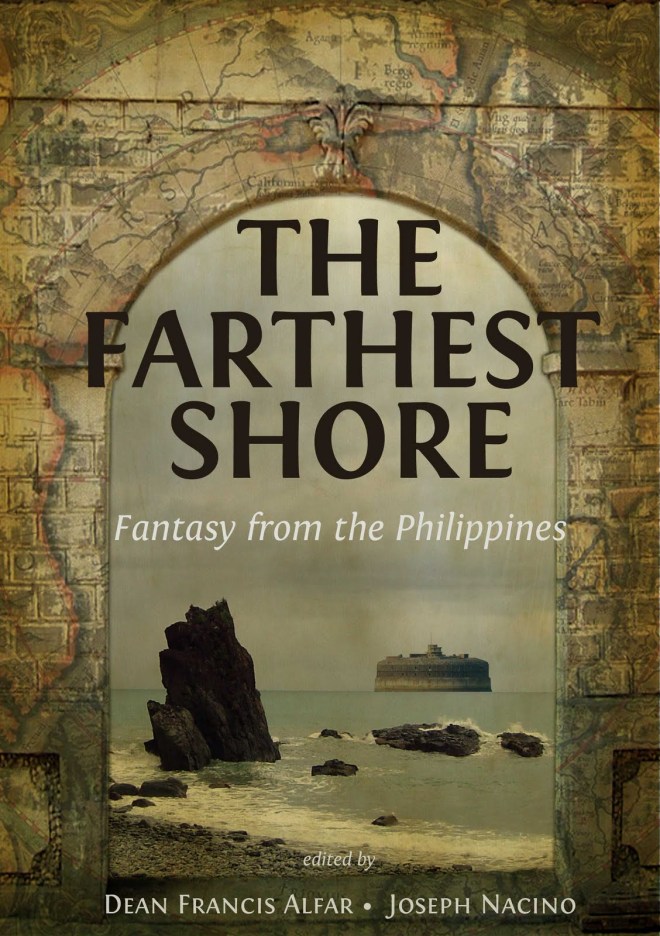
the farthest shore is now live

Clicky -click!

My story in this collection of secondary worlds, “The Just World of Helena Jimenez”, is over here.

Feel free to repost/share the link. :D

meanwhile, somewhere in texas

september_2009_cover

Click here to read the September issue of The Houston Literary Review. “News About the End of the World” is on page 4, just zoom in. :)

Love the cover art.

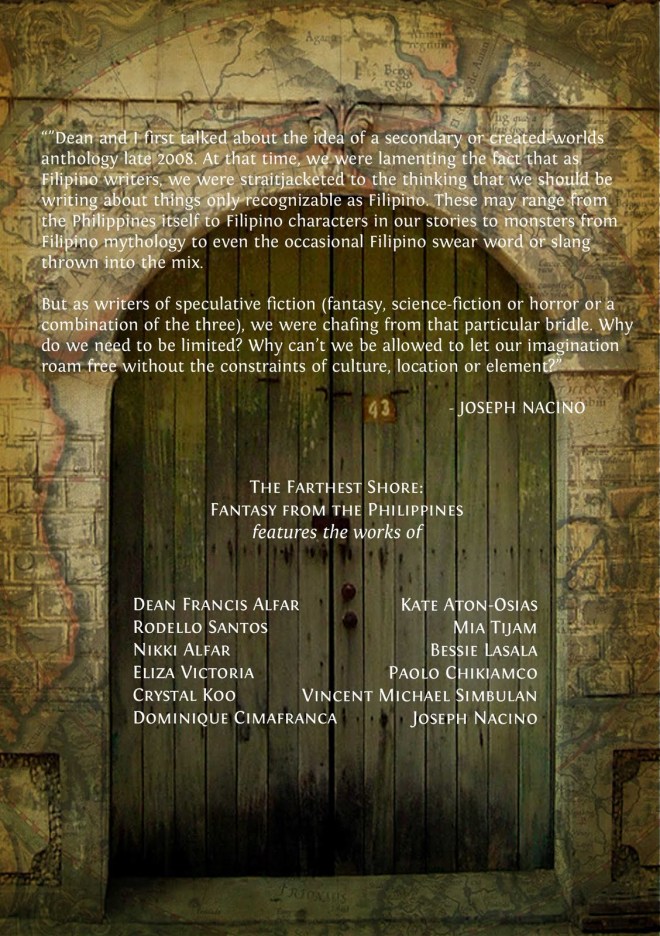
the farthest shore covers

I think I’m in love.

F2W10a

F2W10-backa

From editor Joseph Nacino’s site:

But really, this is just an excuse to show you the final front cover art for The Farthest Shore anthology done by the excellent tyron caliente. Granted the cover is for the PDF download, the art will still be available on the actual website itself.

rocket kapre launches into (cyber)space

rocket kapre

Click on the banner to go to the website, or if you want to go straight to ze goodies, you can click here to read the FAQ, or here to read what some crazy sexy people replied to the question:

RRT-Slider-1-300x187

Rocket Kapre will also run a series of interviews (“On the Far Shore”) featuring the authors of The Farthest Shore. Up first is Kate Aton-Osias.

Now. Who’s behind this insanity?

At present, Rocket Kapre (the blog, the imprint, USOK) is run by Paolo Chikiamco. A lawyer by training and a writer by inclination, in 2009 Paolo resigned from one of the top law firms in the country to establish Eight Ray Sun Publishing Inc., driven to take advantage of the burgeoning ebook market to allow Filipino Speculative Fiction authors a chance, not only to reach an international audience, but to eventually make a living from writing.

Paolo’s articles have appeared in the Philippine Daily Inquirer, Philippine Online Chronicles, and Code RED Magazine. His stories have appeared in the Digest of Philippine Genre Stories, A Time for Dragons, and the Farthest Shore. He won third place in the 2009 Carlos Palanca Awards in the Short Story for Children (English) category. His greatest escapade was sneaking in to watch Total Recall when he was 12 years old. It was totally not worth it.

Paolo can be found on twitter or at the Bahay Talinhaga blog.

Visit and spread the word. Support Filipino authors! :D

i am amused

by this lecture given by the ever-brilliant Conchitina Cruz. She says, My enchantment with genre bending has to do with the possibilities it yields through an unyielding stance toward the question: What is it?

From “To Essay a Poem: Notes on Genre Bending” :

Our creative writing program here in UP, like many others, is organized by genre and divided into three basic tracks: poetry, fiction, and creative nonfiction. On occasions that call for quick descriptions of these strains, it is convenient to go tongue-in-cheek: poets pay attention to sound and image, fiction writers to plot, and nonfiction writers to “what really happened.” Or: poets play with line cuts and language, fiction writers with narrative and time, and nonfiction writers talk about themselves. Easy to tell which genre demands, as far as reputation goes, the most amount of chika and the least amount of skill. Which also explains the order of elimination CW majors typically go through (“Well, it looks like I can’t do fiction, and I know I can’t do poetry, so I guess that leaves…).

There is nothing more tiring than hearing yourself say the same things in the same ways again and again, nothing more exasperating than hearing others say what you are also saying in the same ways again and again, homogeneity being another cause of claustrophobia. If writing is a means of ushering thought into ordered existence, and what you say is how you say it, then the cross-pollinations of the genres can only guard against monotone and redundancy in making possible varieties of articulation and therefore varieties of thought, diverse shapes of imagination.

Read the whole thing; it’s an absolute treat. :D

* * *

Ms Cruz also provides a link to Cesar Ruiz Aquino’s “The Distance to Parnassus: A Palanca Commentary”. In this article, Aquino critiques “three poetry collections-The Gospel According to the Blind Man by Marie La Viña, Sl(e)ights by Ana Maria Katigbak, and Morphic Variations by Francis C. Macansantos-which won in the Poetry in English category of the 2008 Don Carlos Palanca Memorial Awards for Literature. This critical commentary highlights the strengths and weaknesses of each collection in terms of imagery, use of language, manipulation of form and structure, theme, and prosody.”

Interesting! The last time I checked the Palanca website, I was only able to read Marie La Viña’s Gospel, which bagged the 3rd place for Poetry last year (I adore this poem).

I’ll go download and read what Mr. Aquino has to say.