And J and I went over last week to abuse the photobooth. Happy anniversary, Inquirer! Much love to your people. I will always be an Inquirer baby.


And J and I went over last week to abuse the photobooth. Happy anniversary, Inquirer! Much love to your people. I will always be an Inquirer baby.
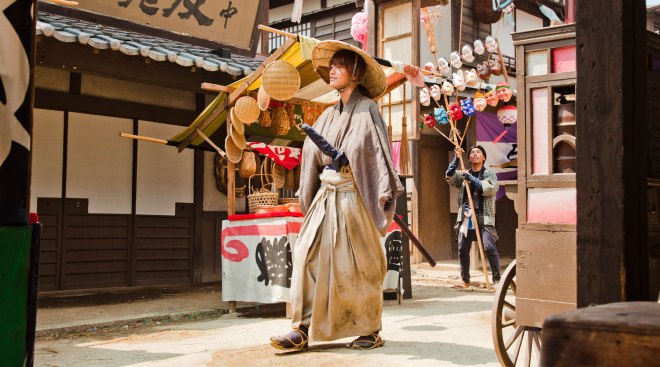
I must say that I thoroughly enjoyed Rurouni Kenshin, the live-action adaptation of anime hit Samurai X. The film, Japanese-produced and distributed by Warner Bros., concerns a wanderer named Himura Kenshin, once a deadly samurai assassin known as Battosai. After the Bakumatsu war, Japan transitions from feudal shogunate to the Meiji government. Some samurai end up as part of the military force of the new government, while others enter a life of poverty and crime. Kenshin, wanting to atone for the lives he has taken, vows never to kill again. This vow is soon challenged.
I cannot call myself a fan of Samurai X because I never got the chance to watch the animated series in its entirety. I know some characters, but know nothing of the major plot points. (To illustrate my ignorance: The first time Sanosuke Sagara appeared onscreen, the people around me started murmuring with delight. I just thought he looked vaguely familiar.) If you haven’t encountered Kenshin’s story before, don’t fret. The filmmakers are able to create an entertaining film with a satisfying plot and excellent cinematography. The film is also successful in showing the pain of change as Japan turns over a new leaf before the 1900’s. “I was starving,” says one of the former samurai, “in this insipid new age of yours.” It has got to be the best line in the film. Casting is laudable, with main man Takeru Satoh able to show the playfulness and darkness of Kenshin.
I just love the final scene. Rurouni Kenshin ends on a great note, a sweet note, that caught me by surprise.
Before November ended, I got an email from the lovely Kristine Ong Muslim, asking me to participate in The Next Big Thing blog cycle, where writers have to answer 10 book-related/self-promo questions about themselves on their blog, then link up to 5 other writers. A chain letter of sorts, but hopefully not an annoying one.

Here we go!
1) What is the title of your latest book?
It’s a short story collection called, A Bottle of Storm Clouds.
2) Where did the idea come from for the book?
One day I just realized that I have enough stories to fill a collection, and wouldn’t that be fun?
3) What genre does your book fall under?
It’s a collection, so it has a bit of everything: horror, science fiction, fantasy, realist.
4) What actors would you choose to play the part of your characters in a movie rendition?
BEN WHISHAW!
Just kidding. He can’t play any of my characters because he’s not Filipino. He can try, but that would be weird.
You know what, I have no idea. Maybe Zanjoe Marudo as Gerardo Nagtahan in “Siren Song”? Really grasping at straws here.
5) What is the one-sentence synopsis of your book?
Sixteen short stories mixing the magical with the mundane.
6) Who published your book?
Visprint!
7) How long did it take you to write the first draft of the manuscript?
These were previously published stories collected since 2007, but some of the stories have been written long before that.
8) What other books would you compare this story to within your genre?
I don’t know.
9) Who or what inspired you to write this book?
Perhaps I should talk about influences: Donna Tartt, Margaret Atwood, Stephen King, Nick Joaquin, Gregorio Brillantes. And my family, who, like most Filipino families, treat the magical and the supernatural as something common.
10) What else about the book might pique the reader’s interest?
It has stories coming from many genres. “Ana’s Little Pawnshop” appears to be a favorite, according to the readers who have approached me, but other readers have different favorite stories, and that’s a wonderful thing.
Tagged, you’re it! Visit these authors’ sites next week, Dec. 19, for their answers.

I love the book this film is based on. I have read the book first, so there is no way to look at the film with new eyes. The novel’s narrative structure is like this: think of six short novels placed on top of one another, and then folded. So you have a complete story in the middle, and halves of the five others on either side. It is a fairly simple structure.
For the film, however, directors Tom Tykwer and the Wachowskis collapsed the structure and decided to tell the six stories parallel to one another, transitioning based on visual cues (a gun pointed upwards at a runaway slave in the 18th century, cut to a hovering ship pointed upwards at a fabricant on a bridge in New Seoul), audio cues (the Cloud Atlas Sextet playing across the centuries – which sounds amazing, by the way), emotional tone (sadness cut to more sadness), and action (climax cut to climax – a futuristic fight scene cut to a daring escape). The result is breathtaking at times, but sometimes I feel this structure forces the (already loose) connections. You find yourself wishing the juxtapositions made more sense.
There is also the questionable decision to make non-Asians play Asians and vice-versa, to drive home the point of reincarnation. The novel, with only words to tell us the story, relied on the recurring appearance of the comet birthmark. But if we’re using the birthmark anyway, is the use of “yellowface” (and blackface, Otherface) necessary?
I didn’t think the filmmakers meant any offense. Making the actors play multiple characters across timelines does add another layer to the story. We see characters reunited. We see Sixsmith transform from a passive holder of records (Frobisher’s letters, the Swanneke report) to an Archivist who may or may not tell the world the truth. But how about Frobisher? From great young composer to music store clerk? A flimsy connection there. And don’t get me started on Yoona~939.
And let’s just be honest here: everyone looks like Spock.

Its weird. And I was looking forward to seeing actual Koreans (or at the very least, actual Asians) in the Sonmi~451 storyline. It’s not like there’s a dearth of Koreans in film right now. John Cho is Korean-American, Hollywood!
Still, Cloud Atlas is a remarkable achievement in filmmaking. I am hesitant to say yes when friends ask, Should I watch it? I feel like I should add a qualifier. Read the book first, or Find out the plot first, or Wait for the DVD so you can watch it with subtitles, because goddamn if I can understand a word far-future Tom Hanks is saying.
But I enjoyed it. It’s almost three hours long, but it engaged me, and I never felt bored.
If the idea of six stories in one film doesn’t daunt you, or if it tickles your curiosity, go watch Cloud Atlas. Despite its flaws, it’s still a rewarding cinematic experience.
My rating: 2 of 5 stars
When I started reading Gillian Flynn’s Gone Girl, I thought it would be similar to Tana French’s Broken Harbour – an exploration of a marriage that is starting to buckle under the pressures of the economic recession, followed by tragedy. In Broken Harbour, the tragedy is murder; in Gone Girl, a sudden disappearance, even a possible abduction.
Nick Dunne is a journalist living blissfully in New York with his beautiful wife, Amy. They seem to have it all: a warm place, cozy jobs, love. Then they lose their jobs during the recession, and are forced to move to Nick’s dying hometown in Missouri. Amy is not happy there. One day, a neighbor calls Nick at the bar where he works and says his door is wide open. He goes home and finds signs of struggle inside their home. Amy is gone.
I came into the story thinking it would be a slow, quiet dissection of a failing marriage. Listen to this: I peeked over the side to see if she was in our rowboat, where I had found her one day, tethered to the dock, rocking in the water, her face to the sun, eyes closed, and as I’d peered down into the dazzling reflections of the river, at her beautiful, still face, she’d suddenly opened her blue eyes and said nothing, and I’d said nothing back and gone into the house alone.
But it turned into something sinister – and bizarre. There is the steady accumulation of characters, at times too outlandish to be considered believable: two psychologist parents basing their book series on their only daughter, an uber-rich man who builds a greenhouse filled with nothing but tulips, a woman often described as smelling “vaginal”. Then the twists came, and –
It’s hard to talk about the novel without spoiling the big plot points, but let me just say that Gone Girl could have been great. Could have been. The first half of the book is brilliant. It could have been a commentary on married life, the recession, suburban unhappiness, modern ennui, the danger in the lies we tell each other, but Flynn decided to transport the story into the realm of the truly abnormal and ridiculous. Maybe for the sake of shock value, but it’s not particularly shocking. Once you get over the first big twist, you realize you’ve seen it all before. And it drags on and on, from one over-the-top subplot to another, down to its hateful end, and by then I have stopped caring. It’s not even insightful. I want to know the why, not the how, and the only answer we get to the why is a cop-out.
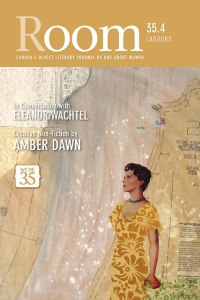
It is Room Magazine‘s 35th Anniversary party on Dec. 9. There is NO way I can be in Canada on Sunday, but I do have a poem called “Hospital Work” in the 35th issue.
Lorrie Miller says: “The jobs that women have often expected to take, domestic or service-based, are well represented in our fiction. Debra Martens, who first appeared in Room in 1987, now brings us the plight of a young waitress. Janna Payne highlights the vocal and the silent in a woman worker as she manages work and being true to herself. Vivian Demuth’s poem takes us on a metaphorical vertical wilderness journey.
Read the introduction: http://www.roommagazine.com/issues/labours
Brooke Wonders in “Everything Must Go” reinvents the tired trope of the drunkard father, the grieving mother, the children caught in between, and the house they have to leave behind, by stretching metaphors to their limits. It’s incredible storytelling, and what language.
He watches his father remove a fifth of Jack from its sock-drawer hideaway and down a few quick swigs. Through his father’s transparent flesh, Bird can see the liquor slide slow down Glass’s throat until it joins the tawny liquid sloshing waist-high. Tiny waves break against his bellybutton. The immediate difference is imperceptible, but as the days rush by, Bird watches the amber tide rise from bellybutton to chest to clavicle, until Glass has filled himself up nearly to the brim, his eyes shiny as bottle caps.
I listened to Kate Baker’s audio adaptation of the story while jogging last night. Enjoy.
http://clarkesworldmagazine.com/audio_11_12b/
Another thing: Carljoe Javier’s Top 10 reads for 2012 is now live on Flipside. A Bottle of Storm Clouds is included in the list! Thanks, Carl.

A Bottle of Storm Clouds by Eliza Victoria
This collection of short stories goes in such a wonderful range of directions. It portrays the familiar, school, kids, family issues, but also delves into worlds strange and fantastic. I have liked Eliza’s writing since I first read it, and this first book of hers is something I have been immensely impressed by.

 Eliza Victoria