sappho beyond hades by jo walton

Source.

Sappho Beyond Hades

Jo Walton

The shades are silent and there is no making.
She misses the warmth of sunlight on stone
and the sound of children playing.
There are children here, but they are all so grave,
like their elders, moving gravely through death’s halls.
She misses the bright constellations, she misses burning.
She has begun to forget the sound of the sea
and the heft of words.
When she has forgotten how to yearn
when not even blood will bring back names to her
she will slip down through Lethe to begin once more
with “Aaa, oooh, milky goo”, and that is a star, and this
is what it means when you get the words right.

stone telling 3 is here!

The Stone Telling Whimsy issue, edited by Rose Lemberg, contains a roundtable discussion led by Julia Rios, nonfiction articles by Deborah Brannon and Nin Harris, and poetry by Jo Walton, Catherynne Valente, Emily Jiang, Sonya Taaffe, Michael R. Fosburg, Caitlyn Paxson, Sara Saab, Susan Rooke, William Doreski, Benjamin Cartwright, Mary Turzillo, and moi. :)

From the introduction:

In “Whimsy” we tilt sideways to look at the world askew – and all kinds of things fall out of the pockets. There’s cloud skeins and language and landscape. There’s salt, and portraiture in mushrooms, and a rice cooker. There’s death, and photosynthesizing cats, and a six shooter called Witty Rejoinder. Boundary-crossing is a serious business.

This issue leaves a trail of hazelnuts. I think it leads to a place unafraid of saying strange true things. New things. Brain-popping things. We flail around for a voice and find pomegranates. We speak of happiness and pain and who we are and how we mesh, but we are not a crowd of lookalikes. Some of us love mythpunk, others disavow genre definitions. We argue, and come up with new stuff. Here- however you define it – here, in this sort of speculative, sort of literary, always in-between liminal space we don’t have to be concerned with conforming, complying, fitting in, faithfully following in the steps. These steps are our own steps. I hope you find what we do here meaningful – and fun.

A few editorial announcements:

Issue 4 will be guest-edited by Shweta Narayan and J. C. Runolfson. Please send them stuff!

My future plans include an International Mythic issue (Stone Telling 5), and a Science and Science Fiction Issue (Stone Telling 6). More information soon!

Congratulations to Stone Telling 1 and 2 poets who were nominated for the Rhysling Award:

Mary Alexandra Agner, “Tertiary” (issue 2)
Tara Barnett, “Star Reservation” (issue 1)
Amal El Mohtar, “The Winter Tree” (issue 2)
Samantha Henderson, “The Gabriel Hound” (issue 1)
Sonya Taafe, “Domovoi, I Came Back” (issue 1)

And finally, I’d like to welcome the newest addition to the Stone Telling team. Jennifer Smith is our tireless proofreader and occasional html wrangler.

Happy reading!
Rose Lemberg, editor
In “Whimsy” we tilt sideways to look at the world askew – and all kinds of things fall out of the pockets. There’s cloud skeins and language and landscape. There’s salt, and portraiture in mushrooms, and a rice cooker. There’s death, and photosynthesizing cats, and a six shooter called Witty Rejoinder. Boundary-crossing is a serious business.This issue leaves a trail of hazelnuts. I think it leads to a place unafraid of saying strange true things. New things. Brain-popping things. We flail around for a voice and find pomegranates. We speak of happiness and pain and who we are and how we mesh, but we are not a crowd of lookalikes. Some of us love mythpunk, others disavow genre definitions. We argue, and come up with new stuff. Here- however you define it – here, in this sort of speculative, sort of literary, always in-between liminal space we don’t have to be concerned with conforming, complying, fitting in, faithfully following in the steps. These steps are our own steps. I hope you find what we do here meaningful – and fun.

A few editorial announcements:

Issue 4 will be guest-edited by Shweta Narayan and J. C. Runolfson. Please send them stuff!

My future plans include an International Mythic issue (Stone Telling 5), and a Science and Science Fiction Issue (Stone Telling 6). More information soon!

Congratulations to Stone Telling 1 and 2 poets who were nominated for the Rhysling Award:

Mary Alexandra Agner, “Tertiary” (issue 2)
Tara Barnett, “Star Reservation” (issue 1)
Amal El Mohtar, “The Winter Tree” (issue 2)
Samantha Henderson, “The Gabriel Hound” (issue 1)
Sonya Taafe, “Domovoi, I Came Back” (issue 1)

And finally, I’d like to welcome the newest addition to the Stone Telling team. Jennifer Smith is our tireless proofreader and occasional html wrangler.

Happy reading!
Rose Lemberg, editor

psa

Okay, maybe you won’t find this important, but I’ll announce it anyway:

I changed my Twitter handle! It is no longer the lame HiElizaHere of old.


Follow me: http://www.twitter.com/elizawriteshere


I’m also thinking of upgrading to a domain name. We’ll see.

“sand, crushed shells, chicken feathers”, reviewed

The Portal recently reviewed the January to February stories published on the World SF blog, and gave a favorable review to “Sand, Crushed Shells, Chicken Feathers“.

The World SF Blog, run by Lavie Tidhar and Charles Tan, was set up in 2009 to carry news and features on science fiction from the world over. For the last few months, the blog has also been publishing fiction (mostly reprints); this is a look at the stories posted in the first two months of 2011, and it is quite a mixed bag. Nick Wood tells a fine tale of a man whose relationship is becoming as dried out as the land. Pyotr Kowalczyk contributes an amusing portrait of a ramshackle trip into space. Michael Haulica’s story of a gastronomic experiment gone wrong is let down by its translation. Ekaterina Sedia’s piece evokes a keen sense of loss as the supernatural meets the real world. Eliza Victoria brings magic into the real world in a different way, magic that’s enigmatic to her readers and characters alike. Stephen Kotowych poses some intriguing questions about time, in a story that doesn’t quite succeed as a whole. And Charlie Human chills with his brief depiction of a new way to fight a battle.

Eliza Victoria’s story “Sand, Crushed Shells, Chicken Feathers” (2010; first published in the Philippine Free Press) concerns two college roommates: John, a firm believer in the supernatural; and Zachary, who is much more skeptical, despite all his grandmother’s tales of magic. Zachary may have cause to question his assumptions, though, when he comes home one day to find John in tears, with the strange voice of an apparently lost girl on the other end of his phone. John was trying to find the spirit of his dead sister, Emma, and instead found two strangers. What really makes this tale work is that Victoria incorporates the supernatural in such a way that it becomes both down-to-earth and mysterious; the magic feels as though it belongs to the contemporary world (with, for example, its use of modern technology), yet one’s sense of exactly how it works and what it does remains murky. The combined effect is nicely unsettling.

The Portal also likedParallel“.

Click on the links if you want to read the reviews and/or stories. :)

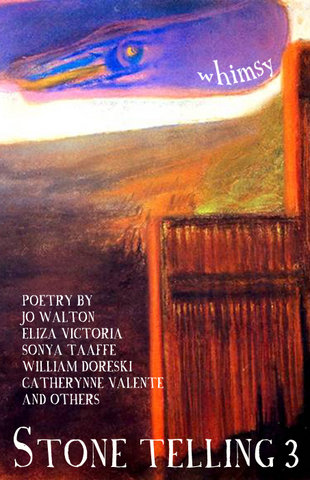
stone telling 3 toc

Eee, I’m so happy to see my name on the cover! Love the colors.

From Rose Lemberg:

As you may have noticed, the third issue is not here yet. I’ve been hit by a particularly nasty flu, and had some other health and work issues that delayed my progress. However, we’re back on track, and the issue should go up sometime next week. Meanwhile, here is the cover and the lineup. I cannot wait to share these poems and columns with you – they are absolutely wonderful.

Poetry:

Jo Walton, “The Weatherkeeper’s Diary”

Ben Cartwright, “Newton’s First Copy of Euclid”
Sara Saab, “11:40PM”
Michael R. Fosburg, “A Dreamed Zodiac”
Caitlyn Paxton, “Firefly Girls”
Susan Rooke, “Jonah’s Widowed Wife”
Emily Jiang, “Rice Cooker Dreams”
William Doreski, “Self-Portrait as Mushroom”
Mary Turzillo, “Moving to Enceladus”
Eliza Victoria, “Sodom Gomorrah”
Sonya Taaffe, Persephone in Hel” 

Catherynne Valente “The Secret of Being a Cowboy” 

Non-fiction:
Deborah Brannon. The Pantoum.

Nin Harris. Visions of Courtly Life Translated into Contemporary Meditations: Muhammad Haji Salleh’s Sajak-Sajak Sejarah Melayu

snowshoe to otter creek by stacie cassarino

Source.

Snowshoe to Otter Creek

Stacie Cassarino


love lasts by not lasting
—Jack Gilbert

I’m mapping this new year’s vanishings:
lover, yellow house, the knowledge of surfaces.
This is not a story of return.
There are times I wish I could erase
the mind’s lucidity, the difficulty of Sundays,
my fervor to be touched
by a woman two Februarys gone. What brings the body
back, grieved and cloven, tromping these woods
with nothing to confide in? New snow reassumes
the circleting trees, the bridge above the creek
where I stand like a stranger to my life.
There is no single moment of loss, there is
an amassing. The disbeliever sleeps at an angle
in the bed. The orchard is a graveyard.
Is this the real end? Someone shoveling her way out
with cold intention? Someone naming her missing?

the tesseract

The novel opens like a thriller. A British seaman waits in a seedy Manila hotel for a rich Filipino mafioso. He notices several things almost all at once: the dead phone, the peephole covered from the outside, rusty blood spatters on the bedsheet, a gunshot hole in the ceiling, a room with no exit. The Filipino don is in a car with his crew, weaving through the dark streets of the city, and the seaman takes out his gun, believing that they are coming to kill him.

Gunshots and a chase – the staples of action movies – but what reeled me in were the characters and their personal tragedies, and the fact that Garland set his story of one, stifling night in Manila.

Such a pleasure to read a familiar world, made new and intriguing by Garland’s compassionate treatment of his characters, his insights, and his crisp, clear, high-energy prose: Back in his room, some of the wetter stains on the street began to glow red as the sun dropped from the sky. Dropped, because the sun didn’t sink in these parts. At six-fifteen, the elastic that kept it suspended started to stretch, and at six-thirty the elastic snapped. Then you had just ten minutes as the orange ellipse plummeted out of view, and the next thing you knew it was night. You had to watch out for that in Manila. Ten minutes to catch a cab to the right side of town if you were on the wrong side.

Garland writes about Manila (and Negros and Quezon Province, in some flashbacks) as both an insider and an outsider. An outsider because he wasn’t born here, an insider because he’s been here, and has (presumably) learned much about the language and the culture. Because the familiar is made foreign (and the foreign made familiar) he sees and describes things I don’t normally pay attention to, like that rapidly sinking sun.

He obviously had fun with using Filipino words for places: Patay, Sugat, Sayang, Sarap. He also liked mentioning Filipino brand names whenever he could. Magnolia, Bench, Inquirer.

There are errors. You don’t write “Yes, po” if in your head the characters are speaking in Filipino (better stick with “Yes”  or write the proper “Opo”), and you don’t say “Mang Don Pepe” because that’s an awkward double honorific (unless of course “Don” is the person’s first name).

But other than that, this is a highly readable book.

Very poignant. Unputdownable.

Read an excerpt.

Listen to an excerpt.

The Mighty Reading List!

Feast for Crows

The Kobayashi Maru of Love

Showbiz Lengua

PGS Horror issue

Floating Dragon

El Bimbo Variations

The Tesseract

The Dispossessed

Our Story Begins

Glass Soup

Here on Earth

The Pull of the Moon

Little Bee