Updates

alone in baguio, day 1

The Victory Liner bus I would be taking to Baguio would leave the Pasay terminal by 6 AM. The ticket said be there 30 minutes before departure, and so, as I’d rather be early and bored than be worried every minute that I might end up late, I was there more than an hour early.

How to purchase bus tickets online

Victory Liner bus schedules

Ha! Take that, TIME!

The buses do leave more or less on time (the 5:30 bus left on the dot; ours left 15 minutes past 6), so, you know, just follow the schedule or else your seat will be given to chance passengers. (And there were a lot of chance passengers that Friday.)

I forgot to pee before the bus left, and had such a terrible bladder experience that the drive from San Fernando, Pampanga to Concepcion, Tarlac was pretty much torture for me. Take note: I rode the regular aircon bus (PhP 455 one way), which has no washroom inside, and which only has two stopovers. One in Tarlac, and another in Sinon, Pangasinan.

It was the Lunar New Year weekend, so traffic was heavy on SCTEX. I arrived at Baguio City past 2 pm, around 8 hours later.

The Victory Liner Baguio station is along Utility Road. I stepped out of the bus and felt a cold wind slap me, and instantly fell in love.

I took a cab from there to Shuntug Road to have late lunch at Cafe By The Ruins. I paid PhP 63 – and the driver gave me exact change. 

Wait-listed at the restaurant.

Got a second floor table, and here’s the view.

I ordered Ruins Coffee and 3 Mushroom Crepe. I loved the coffee. I actually wasn’t expecting much from the crepe, but it was surprisingly delicious and filling.

I hailed another cab to take me to High Point Boutique Inn & Restaurant, all the way in faraway Kennon Road.

Look, when I was looking up hotels online, most of the hotels located along Session Road were so expensive. High Point offered the best price at PhP 3500 for two nights (this is a Standard Room, good enough for two), including free breakfast.

Unfortunately, they’re located 15 to 20 minutes away from city proper. I did not realize this when I booked a room with them. In a city where mostly anywhere interesting is walking distance from each other, that’s pretty far. If you’re staying at High Point and most of your destinations are in Session Road, be ready to shell out cab fare. And I’ve had cab drivers refuse me because Kennon Road is “too far”.

However, if you have a car this won’t be too much of a problem. You can enter Baguio via Kennon Road, for example.

From Shuntug I paid PhP 77 to get to the hotel. The Standard Room is actually pretty spacious.

With the smallest hotel TV I’ve ever seen.

The hot shower takes forever to become hot. And then when it’s hot, it’s scalding. Could annoy some people, but I’m fine with it.

There’s a direwolf on my shirt, because winter is coming here. Sort of.

Outside the room.

So out I went, heading back to Session Road. (I told you. Cab fares. Expensive.)

When I said “Mt. Cloud Bookshop”, the driver looked clueless. So I said, “Casa Vallejo”.

Hello, Mt. Cloud. I’ve been dreaming about you.

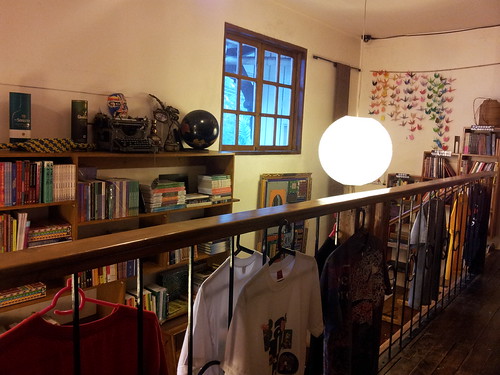
I spent quite a long time here, pulling out a bunch of poetry books and deciding which one to buy. I unfortunately was not made of money, so I placed them all back on the shelf. Then I found something that caught my eye – Madame Apol‘s book! It’s a collection of essays about her move to France. I read a few pages and paid for it at the counter.

It was starting to get dark, so I walked along Session Road. Quite aimlessly at first, until I found the cathedral (Our Lady of Atonement Cathedral).

There was a little store near the church that sold Good Shepherd products. I took a mental note of that.

I stopped by Vizco’s Restaurant (just beside Don Henrico’s) for something sweet.
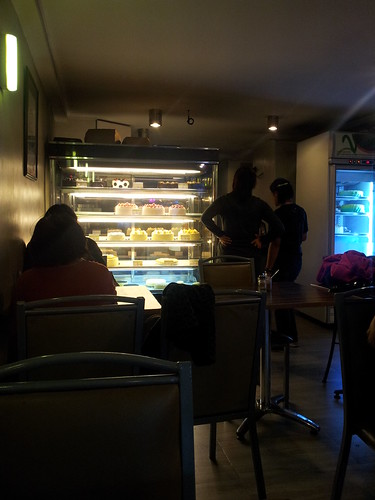
I tried their Strawberry Shortcake, partnered with black tea with honey. Yum.

There were a lot of people walking on Session Road. A lot. I walked toward SM Baguio to get a cab to take me back to the hotel. I climbed the stairs to the mall and was instantly winded – the sun was setting, the temperature was dropping, and my hands, which were uncovered, were starting to freeze.

I was just too glad to be back in my room and under the sheets.

Here I am, someplace else, reading about someplace else.

High Point has reasonably priced meals. I ordered a grilled ham and cheese sandwich with fries, which cost PhP 100. You can have the food delivered to your room, plus 10 percent service charge.

It was a good day. Time to close all the windows, turn off the aircon, put on my socks, and sleep. Brr.

on traveling alone, 2

Lately my stories and poems feel bland. Whatever excitement about my writing that I had end-2013 up to very early this year had faded. So of course the first thought that came to me was: I need a vacation. Haha. Or, I just need to be elsewhere. Am I being too romantic? I feel like I’m being too romantic, but a new place can stir up new ideas. Not earth-shattering ideas, not The Great Filipino Novel ideas, but ideas. I was charmed by Bangkok and I ended up writing a short story (“The Missing“) set in it. I can’t wait to be charmed by another city. Baguio, Dumaguete, Singapore –

Well, of course, it’d be nice if I have a larger disposable income. But oh well. One goal at a time.

‘maximum volume’ launches on feb 28

See you at the Powerbooks Store Greenbelt on Feb. 28 (6 pm) for the launch of Maximum Volume, edited by Dean Francis Alfar and Angelo Lacuesta.

Also, here’s my face. (Source.)

Are you going to the launch?

COMING SOON FROM ANVIL PUBLISHING!

Maximum Volume edited by Dean Francis Alfar and Angelo Lacuesta.

“MAXIMUM VOLUME is not about making noise but about creating space for emerging Filipino writers and new narratives.”

—Excerpt from the book’s introduction by DEAN FRANCIS ALFAR

Launch will be held at Powerbooks Store Greenbelt on February 28, 2014! See you there!

writing advice from kate wilhelm

Kate Wilhelm is a Nebula  and Hugo Award-winning American writer.

Read her full post here.

Words of advice.

There are generalizations that can apply to all writers, such as: In a query letter don’t misspell the editor’s name. Keep records of where and when you submitted your story. Keep financial records to keep the IRS happy. Don’t spend the money until the check has cleared. And so on.

Then there are specific bits of advice that may pertain to any given writer, or not. I agree that writing should be taught by published writers. No matter how long the string of letters behind the teacher’s name, unless there is the experience of writing, rewriting, revising, of hearing what the editor is saying, of bleeding, it doesn’t count for much. Any instructor who is still teaching grammar, syntax, the difference between a gerund and a participle, and so on is not teaching writing. Some years ago a professor we knew was assigned to teach a composition 101 class, to her chagrin. Damon asked her if she was teaching commas, and her reply: “I’m teaching them how to hold their pencils.” A little bit of bitterness there, and a damning condemnation of education. Any beginning writer who has not mastered the tools of the trade by the time he/she graduates high school is in trouble. Most writing workshops have a sorting mechanism in place, a committee or even one person, to determine if the applicant is ready to tackle the difficult process of learning something about writing. It’s a waste of everyone’s time if the workshop has to deal with commas, syntax, formats. Those tools necessary to any writer can be taught, but there is an open question of whether writing can be taught. I can take either side and make a case. I’m reminded of a movie from decades ago in which the director of a Broadway play in rehearsal says to one of the dancers: “I can’t make you a great dancer, but I can make you a better dancer.” I think, at least most of the time, that that is what a good writing workshop can do. It can make almost any writer a better writer. Much of the advice from a professional writer in a workshop or class setting is about what not to do and, more important, why. Usually that is good advice. Don’t make every sentence a simple declarative sentence. Don’t use substitutes for the word “said.” Don’t interrupt a scene to fill in background, have a flashback, or define exactly what the gizmo was supposed to do, and on and on.

For specific advice, sometimes it fits the new writer’s personal style or vision, and sometimes not so much. There is a fiction arc that encompasses the minimalist approach as used by Carver and at his best Hemingway all the way to the other side with the overwrought, some say hysterical, prose of a Poe. There are fans for every style, and writers who lean toward every style ever invented. A Poe enthusiast might not appreciate the Carver style, and advice aimed at the Carver adherent would not be useful for the Poe type. I can tell a writer who wants to be Carver-like how to come closer to that. Take a piece of your fiction and delete every single modifier, every adverb, every adjective. Compare the two pieces and determine what you have to restore, or if by changing a noun or a verb you have to restore any of them. Can changing the verb “entered” to something else–sidled, crept, slithered, crawled–work better? By the time the writer has examined every modified noun and verb and replaced some of them with stronger words, the need for the modifiers may evaporate to a manageable number to produce a leaner, sparer and more effective piece of writing. Also, by now the writer is tired and bored with the piece and my advice is to put both versions aside for a day or two and then compare them. It can be an illuminating exercise. I can’t advise on how to make one’s writing more Poe-like because I don’t admire purple prose. And that’s the point to keep in mind when gathering advice like rose petals. A professional writer’s advice most often reflects what that particular writer finds useful, or tends to reflect what that writer admires, and it may be far from what the new writer needs or can use.

reading update

We got this pack at Shoppers in Ongpin, Manila. It’s nice to drink something warm and tasty while reading. Mmm.

So, what have we been reading?

LocalLocal by Brian Wood & Ryan Kelly

My rating: 5 of 5 stars

A collection of twelve interconnected short stories. Every chapter represents one year in the life of protagonist Megan McKeenan, from age 18 to age 30. Beautiful, beautiful stories, and with great art, too. The art truly shines in the quiet frames, particularly in the largely wordless “Polaroid Boyfriend”. My other favorites are “The Last 10 Lonely Days at the Oxford Theater”  and “Megan and Gloria, Apartment 5A”. “Two Brothers” was a violent surprise.

Batman, Vol. 3: Death of the FamilyBatman, Vol. 3: Death of the Family by Scott Snyder & Greg Capullo

My rating: 5 of 5 stars

I have read all three volumes, and the third one’s the best, sure to go down in history as one of the most disturbing Joker stories. Scott Snyder’s writing is moving.


American ElsewhereAmerican Elsewhere by Robert Jackson Bennett

My rating: 5 of 5 stars

I want to talk a lot more about this book, but I dove into this blind (as I’m wont to do with both books and films), and I would love it if you did the same thing. All you need to know: Mona Bright, ex-cop, inherits a house from a mother who committed suicide when Mona was still a child. The house is in the town of Wink, which was created when a science laboratory was built in the area. The laboratory has been closed for thirty years, and Mona finds Wink an idyllic but strange town. Of course there are secrets. Of course there are strange things that go bump in the dark. I thought it would be a full-on horror novel, but I got something whimsical, and true, and special. Oh, you are in for a treat. If this book were a person I would hug it.

Read it and let’s meet up and talk about it, okay?

I have also read The Ruins by Scott Smith but it wasn’t very good, and 100 Bullets by Brian Azarrello and Eduardo Risso – all 100 issues of it! – which ended up muddy for me, but still an enjoyable read.

imperium e-sports bar and video game lounge + wooden spoon + something about robots

So, what’s up?

My eye grade. That’s what’s up. But I can’t pretend to be too worried about it, it’s a worthwhile excuse to get bigger frames for my big face.

Here:

They made me nauseous for more than a week.

Though frame-shopping is fun, it is expensive. Ugh. Well. Here’s to hoping my eyesight won’t worsen after this year. We got these at Sarabia Optical – Rockwell. The pairs there had price tags that made me miss Nelly Sarabia at the UP Shopping Center. She gives discounts – you should visit her if you’re in the area.

(At one hilarious/frightening point the doctor at Rockwell handed me frames that cost PhP 13K. Are you kidding? For glasses?)

For the first Friday back at work, I tagged along with J’s friends to the Imperium e-Sports Bar and Video Game Lounge in Ortigas Metrowalk. I don’t like bars, but this is a themed one I can get behind.

Except that it’s…pretty blue.

The menu comes in these things because of course they do.

Order drinks in pitchers if you’re in a group.

On the day we got my glasses, we dropped by Wooden Spoon. They have good food and they have great prices. Emphasis on good. Food.

Look at J looking excited.

See the food here? We split that, and we had enough leftovers for dinner. Sulit!

Coffee and cake after.

Project 17 the novel is featured in the December issue of Speed Magazine, and I have an article in the January issue. My thanks to Elaine and the rest of Speed for the compli copies, and for having me.

I am grateful for the holiday break, because I was able to catch up on my reading. But that’s for another post. See ya!

While the Spanish colonizers relied on friars and the mestizo class to rule the Philippine archipelago, the Americans — despite their egalitarian policies, democratic rhetoric, and efforts to ‘Filipinize’ the state — relied on Spanish-era elites — intent on preserving the status quo and expanding their base of power in a new period of prosperity — to ‘govern’ the country. The modern Filipino state, largely built and upgraded during the American period, had a simplistic democratic accent: elected legislature. The problem was that the ‘representative’ legislature was dominated by the landed elite, who, in turn, did their best to block any effort at developing an independent and powerful state, executive leadership, and bureaucracy, which could push for egalitarian policies such as land reform. There was no corresponding effort by the colonial masters to truly establish a powerful executive and bureaucracy, capable of prospering on its own. In this sense, one could say that — following Isaac Berlin’s concepts of freedom — the Philippines (under its colonizers) only developed an adulterated understanding of democracy, along libertarian lines, which emphasized ‘negative freedom’ (non-interference/intrusion of the state in individual’s lives and property) at the expense of ‘positive freedom’ (basic social and economic rights for all citizens). As a result, the Philippines has had not only a defective democracy — whereby citizens are formally equally, but in reality an oligarchy is in charge — but also a weak state struggling to craft an optimal economic calculus.


From “Why the Philippines Failed?” by Richard Javad Heydarian on the Huffington Post.

Reading this, thinking about this.