how to donate to japan via paypal

If you have a PayPal account and wants to help Japan in your own little way, click here.

You can donate any amount to participating non-profit organizations. I donated to GlobalGiving’s Japan Earthquake and Tsunami Relief Fund.

GlobalGiving supports grassroots projects around the world. This project will disburse funds to organizations providing relief and emergency services to victims of the earthquake and tsunami in Japan. GlobalGiving is working with International Medical Corps, Save the Children, and other organizations on the ground to provide relief to victims.

Washington, DC 20005

You may also donate via the Philippine National Red Cross.

If you know of other ways to donate, just leave a comment. Thanks!

about the fukushima nuclear accident

Found this helpful link on Twitter (with an update here). It’s a long read, and includes an explanation of how nuclear power plants work and fail, but you might want to focus on the last part (bold passages mine):

Now, where does that leave us?

  • The plant is safe now and will stay safe.
  • Japan is looking at an INES Level 4 Accident: Nuclear accident with local consequences. That is bad for the company that owns the plant, but not for anyone else.
  • Some radiation was released when the pressure vessel was vented. All radioactive isotopes from the activated steam have gone (decayed). A very small amount of Cesium was released, as well as Iodine. If you were sitting on top of the plants’ chimney when they were venting, you should probably give up smoking to return to your former life expectancy. The Cesium and Iodine isotopes were carried out to the sea and will never be seen again.
  • There was some limited damage to the first containment. That means that some amounts of radioactive Cesium and Iodine will also be released into the cooling water, but no Uranium or other nasty stuff (the Uranium oxide does not “dissolve” in the water). There are facilities for treating the cooling water inside the third containment. The radioactive Cesium and Iodine will be removed there and eventually stored as radioactive waste in terminal storage.
  • The seawater used as cooling water will be activated to some degree. Because the control rods are fully inserted, the Uranium chain reaction is not happening. That means the “main” nuclear reaction is not happening, thus not contributing to the activation. The intermediate radioactive materials (Cesium and Iodine) are also almost gone at this stage, because the Uranium decay was stopped a long time ago. This further reduces the activation. The bottom line is that there will be some low level of activation of the seawater, which will also be removed by the treatment facilities.
  • The seawater will then be replaced over time with the “normal” cooling water
  • The reactor core will then be dismantled and transported to a processing facility, just like during a regular fuel change.
  • Fuel rods and the entire plant will be checked for potential damage. This will take about 4-5 years.
  • The safety systems on all Japanese plants will be upgraded to withstand a 9.0 earthquake and tsunami (or worse)
  • I believe the most significant problem will be a prolonged power shortage. About half of Japan’s nuclear reactors will probably have to be inspected, reducing the nation’s power generating capacity by 15%. This will probably be covered by running gas power plants that are usually only used for peak loads to cover some of the base load as well. That will increase your electricity bill, as well as lead to potential power shortages during peak demand, in Japan.

If you want to stay informed, please forget the usual media outlets and consult the following websites:

*

My brother and I (and several other people) have been receiving text messages about the Fukushima incident causing acid rain and radiation sickness in the Philippines.

Dear source of the stupid texts: Maybe you’re just scared, or stupid, but please please WILL YOU PLEASE JUST FUCKING STOP. Panic will get us nowhere. We need credible information.

on japan

What happened in Japan was the worst disaster I have ever seen and heard in my life. An earthquake followed by aftershocks with magnitudes comparable to major earthquakes (a magnitude 6 earthquake marked as an “aftershock” – can you imagine?), a tsunami that swept through the Pacific and reached the coast of California, a possible nuclear meltdown in one of its power plants, and fatalities possibly in the thousands.

The earthquake was so strong that it moved the main island of Japan by 8 feet and shifted the planet on its axis by nearly 4 inches.

I can still remember how terrified I was when I realized that wishing the tsunami away wouldn’t do any good because it was already on its way, it was only a matter of time. At least 20 countries were warned and monitored the wave as it approached, like victims bracing for impact.

Thankfully it didn’t do damage in the Philippines.

Thankfully it didn’t happen in the Philippines, or we wouldn’t have survived it. We are so ill-equipped, so ill-prepared, and so stubborn.(Remember the concerns raised after the tsunami hit Indonesia in 2004? When Ondoy came years later we still didn’t have enough rubber boats to rescue stranded citizens. Jesus Christ.)

Thankfully we didn’t revive the mothballed Bataan Nuclear Power Plant. One earthquake, and we’d surely be covered not only with rubble but also with radioactive fallout.

I’ve always been against nuclear energy -just so many risks, and where will we stash the waste? – but I didn’t wish to be validated in this way.

Nature operates on the principles of balance and cycle and order – it does not operate on morality. It doesn’t happen to you because you’re evil, it does not not happen to you because you’re good. That’s why to die or suffer from nature’s effects is so painful, because you are not taken into consideration, because you cannot blame anyone, because you cannot ask for mercy.

But I do so fervently hope nature would spare us and allow people to rebuild in peace.

day: notes

(There were 57 people confirmed murdered on Nov. 23, 2009. The 58th victim is still missing. This poem originally appeared in High Chair, Issue 12.)

1.
We can be buried by the things that do not worry us at this hour.

2.
This car the only car on this street.

3.
We talk about breakfast as if it were sacred. No child knocking on our windows, no display of garlands. Only an idling garbage truck, men fixing a crooked billboard.

4.
(Beggars knock on the glass, so you knock back, and they move on. When did it come to pass that a knock meant I am alive but I am not here? When did it come to pass that a knock meant No?)

5.
The trains are dead at this hour, but I only had the heart to say, The trains are silent.

6.
57 bodies. They knock outside my car window, and I knock back because I am weak.

7.
What is the point of my telling you this?

8.
All around you, suddenly: a shielded radiance, a muted glory. Perhaps you’ll look at me and think, There is no real kindness in the world, but don’t we know this already?

9.
On that road, a man in a sweat-stained uniform is saying, Here. And here. And here.

10.
We have never been there. We will never be there. Before the guns were fired into their faces the victims must have thought, No help will come to me now, and they were right.

11.
An afterlife? Perhaps. Perhaps it is a place. Perhaps in that place is clarity. A blinding. But right now we can still see. For example, I still like flowers. I still look forward to the smell of morning. Here. And here. And here. The places where you want to be kissed.

12.
I collect them like newspaper clippings. A gesture that makes me smile, or perhaps a moment that makes me feel worthless. Here is the trick in begging: put a few coins in the can to fool people about your worth. All I want to say: I was not empty when I first came to you.

13.
And now this morning that does not find them in it. The knocking on glass as we read about mutilated genitalia, an exit wound the size of a saucer. A coin clangs on the bottom of the can. Please. Please. Please.

14.
The sun rose the day after the massacre. This is either indifference, or a show of an infinite mercy.

15.
– It is still dark.
– We are not frightened.
– We turn away like the morning.
– We dream of an open field.

soapbox

Not really. I’m too angry and sad to even say something coherent. I mourn the lives lost, the relatives left with their pain. If only we can go back to Monday night. The man just wanted his job back – if authorities gave in to his demands, he would have calmed down, he would have realized that he was doing a stupid, pointless thing, and no one would have died.

Ten things the Philippine bus siege police  got wrong – BBC

DILG chief admits problems in hostage handling – Inquirer

Angry messages flood Aquino’s Facebook – Inquirer

a book review, and then some

In the second installment of A Song of Ice and Fire, King Robert Baratheon is dead, and four kings insist their claim to the Iron throne: the boy Joffrey, Robert’s eldest son but is believed to be the fruit of his mother’s incestual relationship with his uncle Jaime, the Kingslayer; the boy Robb, Ned Stark’s eldest son and self-proclaimed King of the North; and Robert’s brothers, Renly Baratheon, who commands several Houses who have sworn their allegiance; and Stannis Baratheon, Robert’s brother, who has dismissed the old gods for the more powerful (but suspicious) Lord of Light. Meanwhile, Sansa Stark is still held hostage by the Lannisters, Jaime Lannister is held hostage by the Starks, Arya serves at the Lannister-controlled Harrenhal but keeps her identity secret, and Daenerys of House Targaryen tries to find a way to land an army on Westeros and unleash her dragon-children. In the sky, a blood-red comet passes, spelling both doom and victory, depending on who is looking.

With such a complex plot and so many characters, a less skilled writer would have ended up confusing readers, and maybe even confusing himself, but Martin’s storytelling is strong and sure. And such twists! And such suspense! Martin is testament to the fact that you can produce a novel that is fast-paced and action-packed, but still let the language shine through. A really good read.

(The third book is A Storm of Swords and is already waiting for me over at Jaykie’s, but I’ll take a break from Martin for a bit to read The River King by Alice Hoffman, which was lent to me by Kat. :) )

* * *

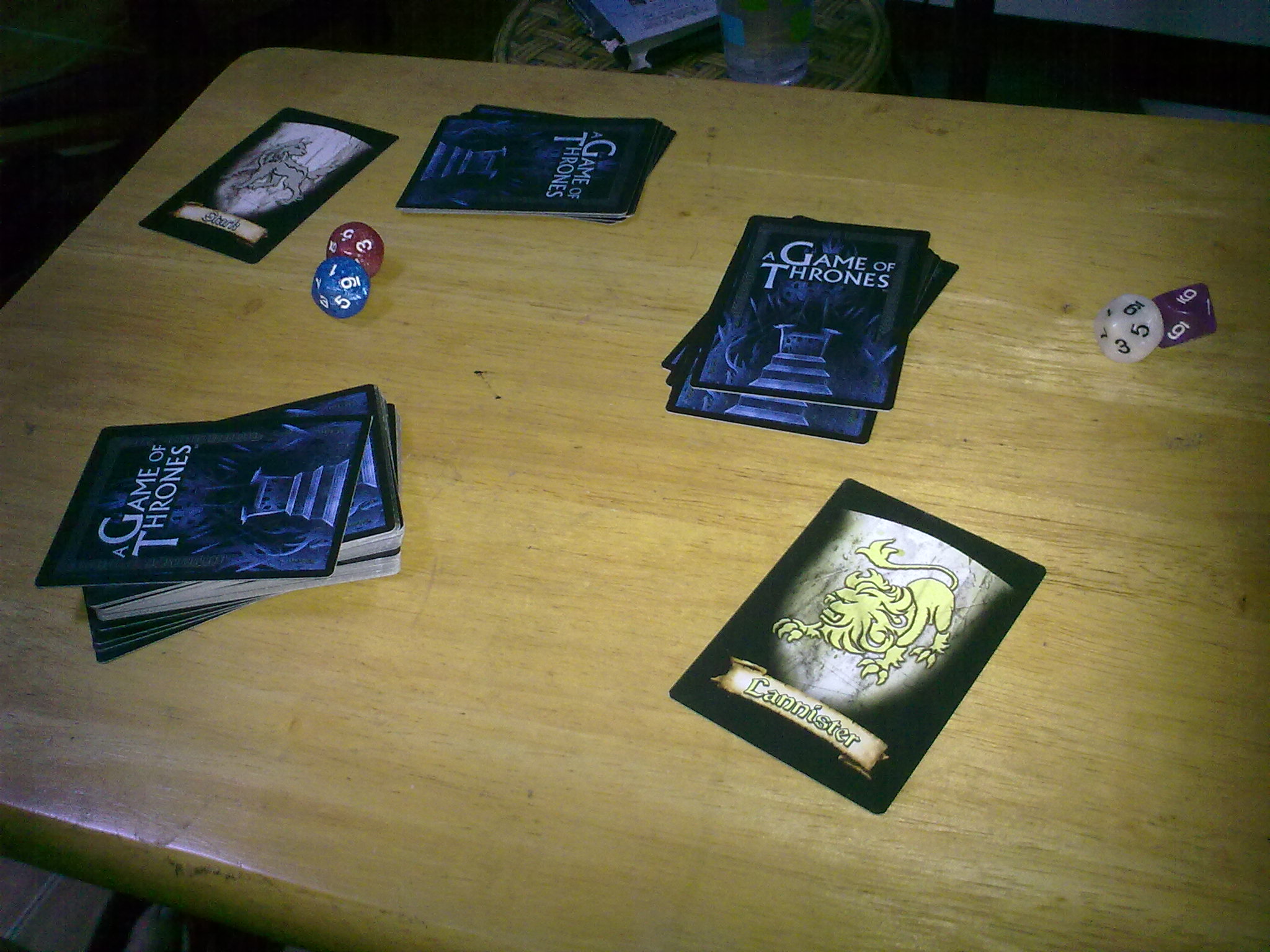
Speaking of Martin, I’ve been seeing this card deck at Jaykie’s

and I’ve been asking him to teach me how to play for days, so on Friday we finally sat down for a round:

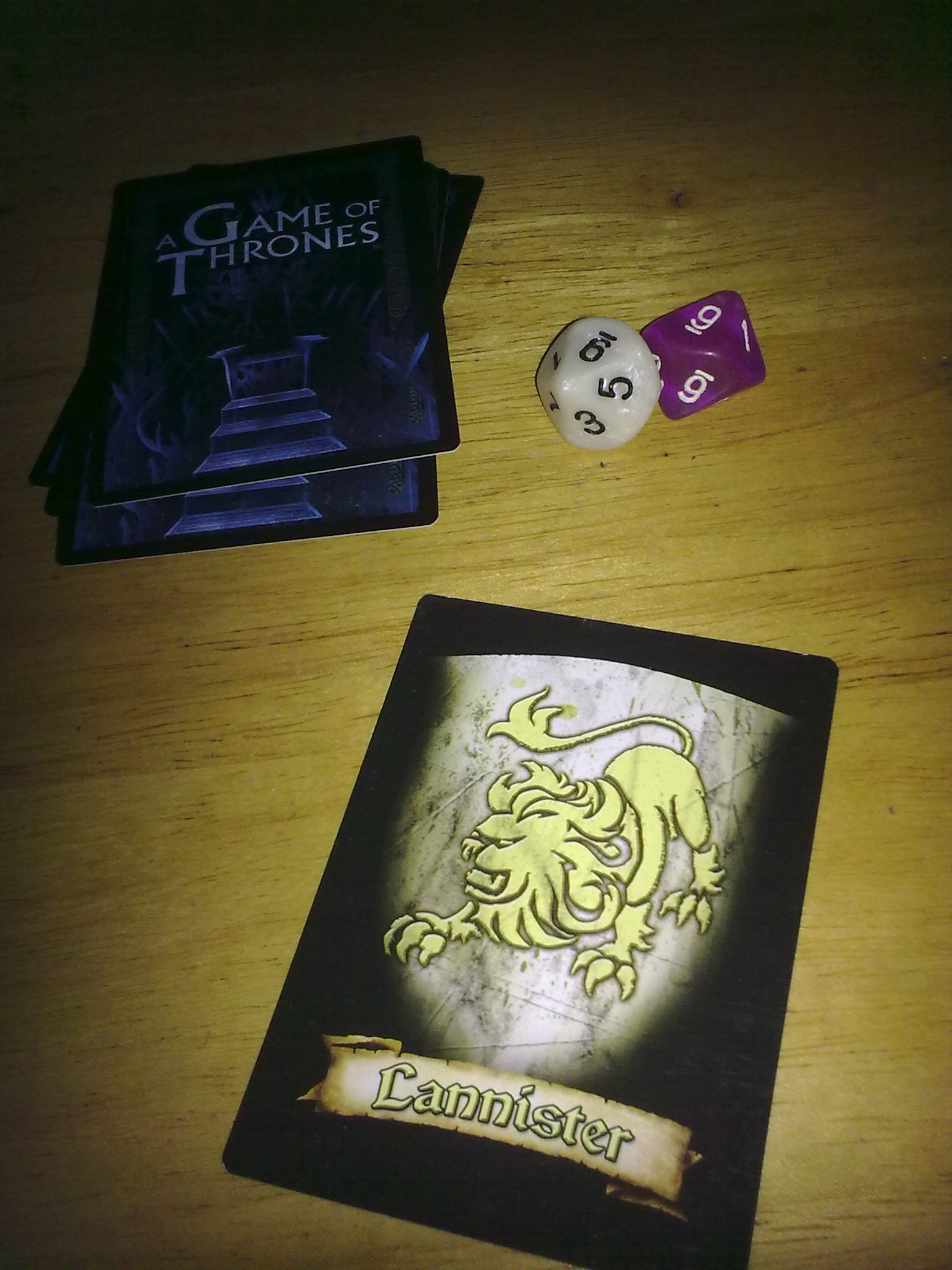
I controlled House Lannister:

I lost! LOL. But I found this card game easier to understand than Magic. The art is awesome.

* * *

Speaking of awesome art, after I came back from the weekend I found this sitting on my bed:

Inside the packet are complimentary copies and a letter from GASFI. Thank you so much! :D

I don’t know if the book has already hit the book stores, but if you ever come across a copy, flip through the pages for a preview and maybe buy one for the kiddies? :) The book is published on glossy paper and the art is lively and bright. I really love Ray Sunga’s artwork here. My first children’s book! *squee*

* * *

And speaking of stories, thanks to Don Jaucian for including “The Just World of Helena Jimenez” in his list of spec fic best-reads in 2009. You may read that story here.

* * *

A lovely sound: Former President Gloria Macapagal-Arroyo.

Halfway through this year and I’m lovin’ it.

Mareklamo nga lang ang ating bise-presidente. Hay, kuya. Ang buong Pilipinas AY HINDI MAKATI.

Nakaka-turn off ka. ‘Yun lang.

big story sale

I got this lovely news in the mail today:

Dear Eliza Victoria:

We are delighted to accept your story “December” for a forthcoming issue of the print edition of Story Quarterly and, if possible, for Story Quarterly Online, the electronic edition of our print magazine, where work is reproduced as protected PDF files and in the form of audio (MP3) files.

[redacted]

Sincerely,
J.T. Barbarese
Editor, Story Quarterly at Rutgers-Camden
Rutgers University
Department of English
Camden NJ 08102
http://www.camden.rutgers.edu/storyquarterly/

If this works out, “December” will be my first pro sale. Story Quarterly has published the likes of “Margaret Atwood, Anne Beattie, Frederick Busch, Joyce Carol Oates, T.C. Boyle and Jhumpa Lahiri.”

Great crowd! I love it! :D

* * *

To all those who attended the event yesterday, thank you, and thank you also if you were among those who stopped in their tracks to talk to us lowly researchers. Heh. The article’s over here, m’lovelies. ♥

MANILA, Philippines—Some 80 questions were asked in the first-ever Philippine Daily Inquirer Presidential Debate held Monday at the University of the Philippines (UP) Theater in Diliman, Quezon City, but those who came wanted to ask more.

Sen. Benigno “Noynoy” Aquino III should have been asked about Hacienda Luisita, “and why he has not done much as a senator,” said C, 54, a businesswoman.

Another, who decided to be anonymous, said: “Noynoy should have been asked about Hacienda Luisita. Up to now, no forum had personally asked him about this issue.”

But Elizabeth San Diego of Quezon City disagreed. “I have already read and heard a lot about the case of Hacienda Luisita so I did not want to hear more about it anymore,” she said.

Amer Amor, a professor at UP Baguio, said, “I expected that someone would ask former Defense Secretary Gilberto Teodoro about his links to President Arroyo.”

A 20-year-old student leader said he would have wanted to ask Sen. Manuel “Manny” Villar: “How much money does a candidate have to spend on political ads?”

Here’s an article about the forum itself, in case you failed to attend. Orayt. :)