My poem, “Variations on the Expulsion from Eden”, is now up on the elimae website (August issue). Click here, if you are so inclined.
Category: plug
sf with heart: apex magazine # 14 review
Pinoy Pop continues its survey of online speculative fiction magazines this week with a look at the latest issue of Apex Magazine. Apex Magazine started out in 2005 as the Apex Science Fiction and Horror Digest, published by Apex Publications. Two years and twelve digests later, Apex Publications became a full-fledged independent publishing house with the creation of the Apex Book Company. The digest then became a digital magazine in constant search for dark speculative fiction and poetry.
Issues, released every first Monday of the month, are available online and as free PDF downloads. Readers are also encouraged to buy a digital copy, or make a donation of any amount as a show of support to the authors and editors.

Issue 14 marks managing editor and owner Jason Sizemore’s “last go around as fiction editor for a while”. Next month’s issue will be helmed by award-winning author Catherynne M. Valente.
No endings or major plot twists are given away in this review, but for the purists, spoiler warning commences here.
poses and prostitutes: beneath ceaseless skies 46 review

If you find yourself in the mood for an adventure, you might want to read an issue of Beneath Ceaseless Skies, an online magazine dedicated to publishing the best in literary adventure fantasy. The magazine, which publishes two stories per issue and releases a new issue every two weeks, publishes “traditional adventure fantasy, including classics from the pulp era and the new wave of post-Tolkien fantasy” from interested writers, but Scott Andrews (publisher and editor in chief) and Kate Marshall (assistant editor) say they also “love how the recent influence of literary writing on fantasy short fiction has expanded the genre, allowing writers the freedom to use literary devices such as tight points-of-view, round characters, unreliable narrators, discontinuous narratives, and others. This sophisticated level of craft has made fantasy short fiction more powerful than ever before.” You can see for yourselves the expression of this editorial vision in their magazine. Today, let’s review BCS’s Issue # 46: (now archived, the stories are still available online. The issue is also available as a PDF, mobi, epub file, and at the Kindle store.) Spoiler Warning starts here, so go read the issue first, then come right back, you hear?
aftermath, and new poem
I’m hearing news that Meralco has so far energized more than 90 percent of the Metro, but as of last night the stat was as low as 20 percent and Makati looked like the site of apocalypse. Cables hanging dangerously low, dark streets, dead traffic lights, candles sitting on windowsills. Our condo building has a generator, but at 9 p.m. last night our unit’s still gloomy and humid. Apparently the utility men couldn’t connect the unit to the generator. What infuriated me was that there was a goddamn party near the pool area. With ear-blasting music. And huge speakers. I should have pushed the lot of them into the pool so we could use the leftover power to heat our water.
Anyway. I was thankful to Jake and his family for inviting me to stay over. They were at the Marriott while waiting for power to come back to their home. There were only two beds in the room, so Jake pushed two sofas together. Initially he wanted to sleep there, or sleep on the floor, but I fit on the sofas anyway. Nice and cozy. Had a good night’s sleep. :) I texted my mother, and she said we have electricity back home, so I’m traveling to Bulacan with two short story collections (borrowed from Andrea) that I’m planning to finish over the weekend.
* * *
I just received the good news that my poem, “Variations on the Expulsion from Eden”, will appear in the August issue of elimae. A year ago elimae published “Storytellers“. Click the link to read, and watch this space. ;)
lightspeed magazine #1 review

There is a new online magazine in town, and this one focuses exclusively on science fiction.
Lightspeed Magazine, launched in June, is helmed by Fantasy Magazine and Prime Books publisher and award-winning editor Sean Wallace, with editorial support from John Joseph Adams (Fiction), Andrea Kail (Nonfiction), Stefan Rudnicki (Audio), and Jordan Hamessley and Christie Yant (assistant editors). A glance at the magazine’s impressive staff box shows that aside from showcasing fiction, Lightspeed also publishes nonfiction pieces, which can be read as companion pieces to its fiction offerings, and serves up a podcast, featuring one or two stories each month in audio format.
A fiction and a nonfiction piece is posted online for free every week, but readers have the option to buy the complete issue in ebook form at any time, even if there’s only one story for that month available on the website. The magazine’s regular monthly publication schedule (following this debut issue) will include two pieces of original fiction and two fiction reprints, along with four nonfiction articles. Fiction (and podcasts, when applicable) will go live on Tuesdays, nonfiction on Thursdays.
According to Adams, “Here you can expect to see all types of science fiction, from near-future, sociological soft SF, to far-future, star-spanning hard SF, and anything and everything in between. No subject will be considered off-limits, and we encourage our writers to take chances with their fiction and push the envelope.”
It was a promise delivered in Lightspeed’s maiden issue, which features four all-new, never-before-published stories from Vylar Kaftan, Jack McDevitt, David Barr Kirtley, and Carrie Vaughn. The magazine as a whole has been well received–see a review at Tor.com and the Secret Lair, even at SF Signal though the reviewer felt let down by the non-fiction; Locus doesn’t so much as review the entire magazine as each individual story.
a book review, and then some

In the second installment of A Song of Ice and Fire, King Robert Baratheon is dead, and four kings insist their claim to the Iron throne: the boy Joffrey, Robert’s eldest son but is believed to be the fruit of his mother’s incestual relationship with his uncle Jaime, the Kingslayer; the boy Robb, Ned Stark’s eldest son and self-proclaimed King of the North; and Robert’s brothers, Renly Baratheon, who commands several Houses who have sworn their allegiance; and Stannis Baratheon, Robert’s brother, who has dismissed the old gods for the more powerful (but suspicious) Lord of Light. Meanwhile, Sansa Stark is still held hostage by the Lannisters, Jaime Lannister is held hostage by the Starks, Arya serves at the Lannister-controlled Harrenhal but keeps her identity secret, and Daenerys of House Targaryen tries to find a way to land an army on Westeros and unleash her dragon-children. In the sky, a blood-red comet passes, spelling both doom and victory, depending on who is looking.
With such a complex plot and so many characters, a less skilled writer would have ended up confusing readers, and maybe even confusing himself, but Martin’s storytelling is strong and sure. And such twists! And such suspense! Martin is testament to the fact that you can produce a novel that is fast-paced and action-packed, but still let the language shine through. A really good read.
(The third book is A Storm of Swords and is already waiting for me over at Jaykie’s, but I’ll take a break from Martin for a bit to read The River King by Alice Hoffman, which was lent to me by Kat. :) )
* * *
Speaking of Martin, I’ve been seeing this card deck at Jaykie’s
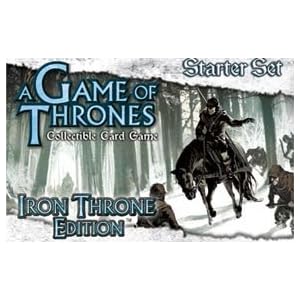 and I’ve been asking him to teach me how to play for days, so on Friday we finally sat down for a round:
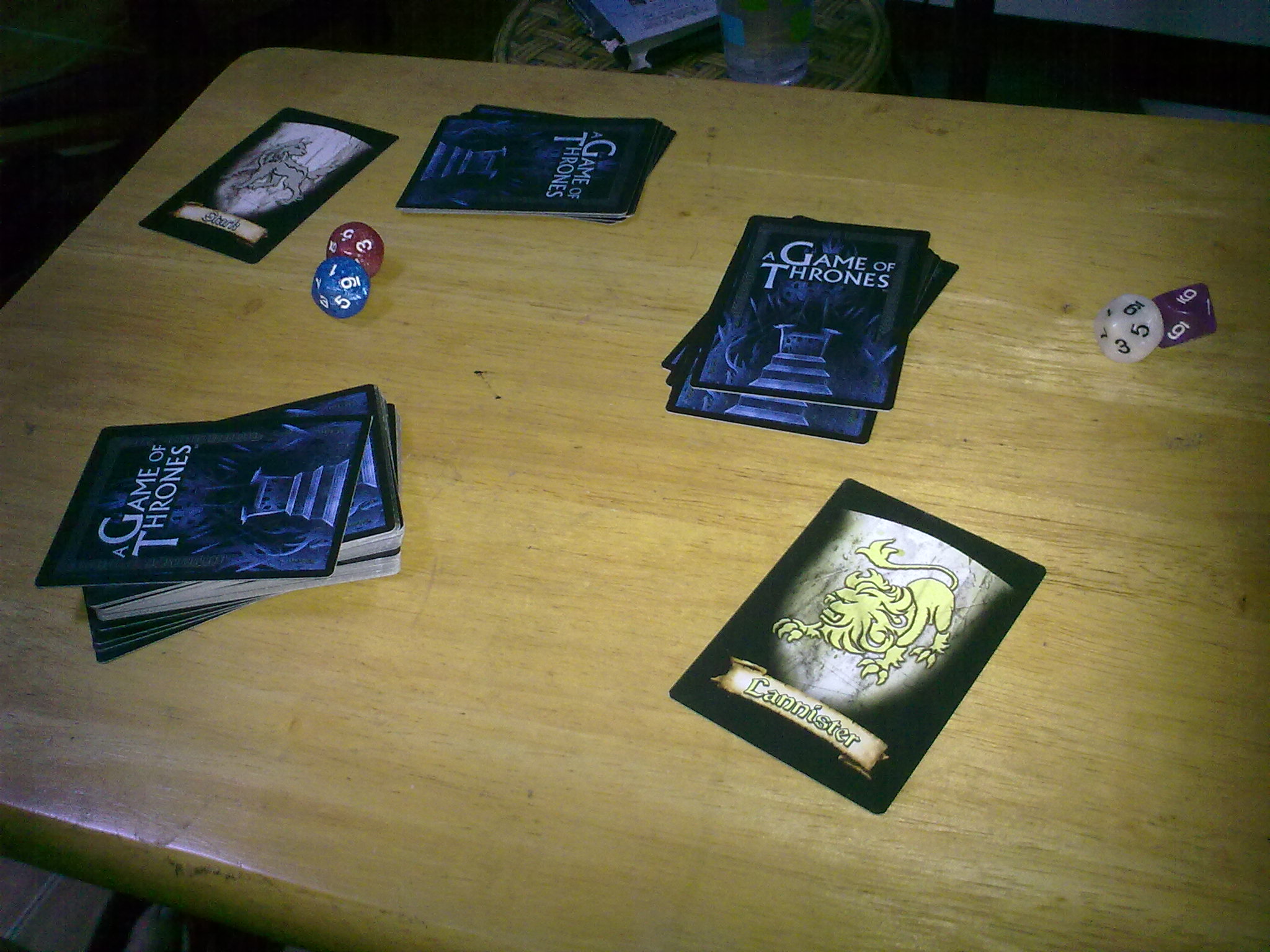
I controlled House Lannister:
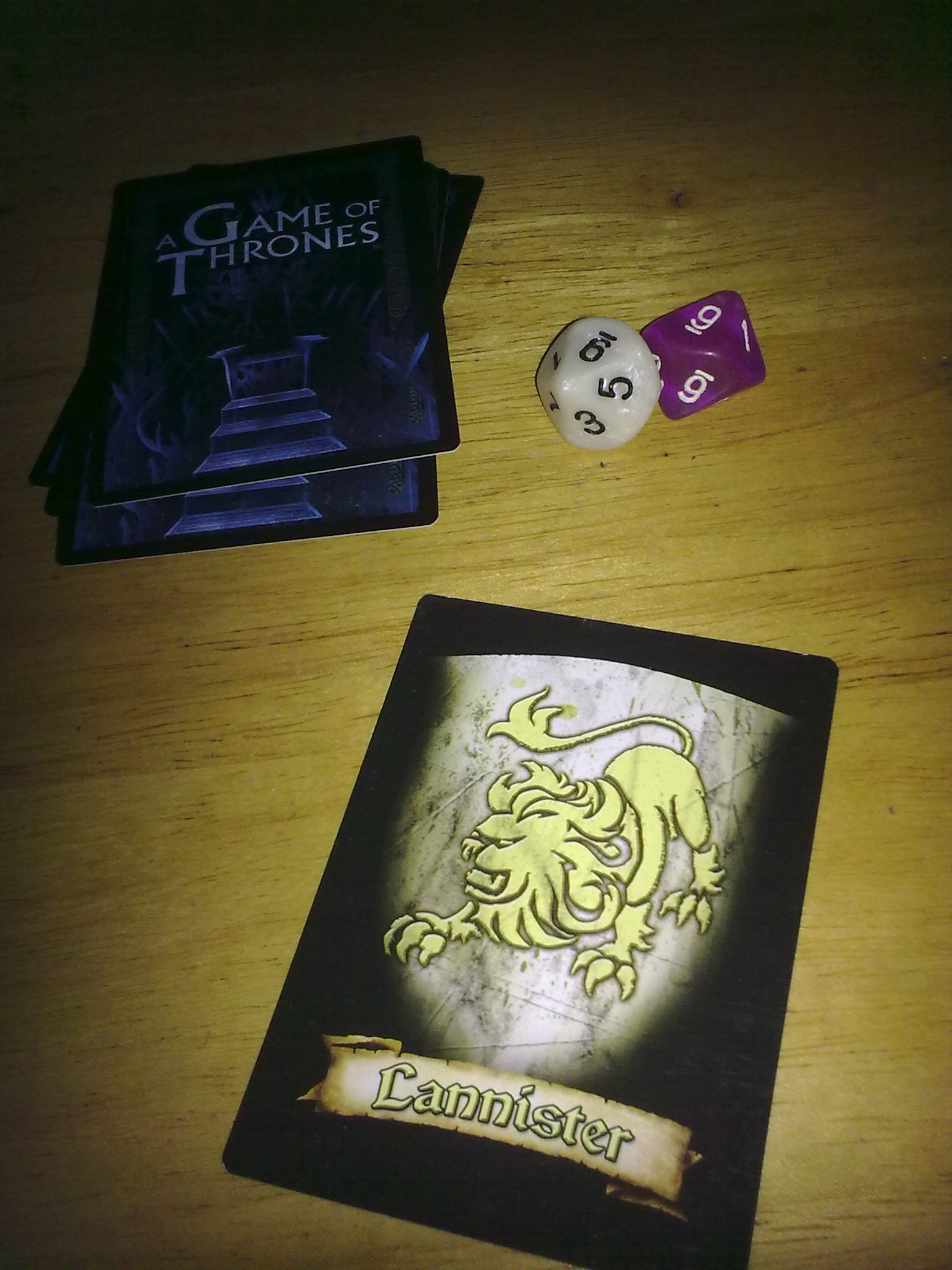
I lost! LOL. But I found this card game easier to understand than Magic. The art is awesome.
* * *
Speaking of awesome art, after I came back from the weekend I found this sitting on my bed:


Inside the packet are complimentary copies and a letter from GASFI. Thank you so much! :D
I don’t know if the book has already hit the book stores, but if you ever come across a copy, flip through the pages for a preview and maybe buy one for the kiddies? :) The book is published on glossy paper and the art is lively and bright. I really love Ray Sunga’s artwork here. My first children’s book! *squee*
* * *
And speaking of stories, thanks to Don Jaucian for including “The Just World of Helena Jimenez” in his list of spec fic best-reads in 2009. You may read that story here.
* * *
A lovely sound: Former President Gloria Macapagal-Arroyo.

Halfway through this year and I’m lovin’ it.
Mareklamo nga lang ang ating bise-presidente. Hay, kuya. Ang buong Pilipinas AY HINDI MAKATI.
Nakaka-turn off ka. ‘Yun lang.
multiethnic lovecraft: innsmouth free press #4 review
OK, before I begin, let me state this up front: I have never read an H.P. Lovecraft story. Or perhaps I have, but have just forgotten. (And yet for some reason I know how to pronounce “Cthulhu”.)
Give me a few minutes to wipe off the tomato stains from my shirt.

Now that the understandable outrage is out of the way: while I have never read an H.P. Lovecraft story, the Mythos he has created is so pervasive that I had a good idea of what to expect from the fourth issue of Innsmouth Free Press (a webzine which acts as “a fictional newspaper publishing faux news pieces – lovingly called Monster Bytes – in a Lovecraftian/Cthulhu Mythos universe, as well as original short fiction stories”): monsters and old gods and weird horror… and, because of the particular focus of this issue, a multiethnic slant.
In the Editorial by Silvia Moreno-Garcia (Publisher) and Paula R. Stiles (Editor-in-Chief), they describe the origin of this issue’s focus in this way: “When we first devised the special Multiethnic issue, we thought the approach would be simple: take the New England out of Lovecraft. Our reasoning? Lovecraft’s fiction focuses on the alien experience and we sought to define what was alien in an interesting way, by travelling to different locations and using different characters than he would have used to tell a story. Lovecraft’s troubles with race and gender have been made famous in his very writing. But by raising them, he also asked questions with a variety of possible answers far beyond what he himself might have tolerated. The mark of a great writer is the universal application of his/her work and we wanted to find writers who could ask Lovecraft’s questions in new cultural contexts.”
There’s also a good interview with Moreno-Garcia and Stiles up on Tor.com, where they talk about how they first discovered Lovecraft, and the different interpretations they’ve seen, and the means by which the Lovecraftian tradition is being expanded.
Now what did Moreno-Garcia and Stiles mean by “Lovecraft’s troubles with race and gender”? Let’s turn to Professor Wikipedia: Lovecraft lived at a time when the eugenics movement, anti-Catholicism, Antisemitism, nativism, and strict racial segregation and miscegenation laws were all widespread in the United States, and his writings reflect that social and intellectual environment. A common dramatic device in Lovecraft’s work is to associate virtue, intellect, civilization, and rationality with upper class White Anglo-Saxon Protestants. These are often posed in contrast to the corrupt, intellectually inferior, uncivilized and irrational attributes which he associated with both the lower classes in general and those of non-Anglo Saxon ethnicity, especially those who have dark skin. He held English culture to be the comparative pinnacle of civilization, with the descendants of the English in America as something of a second-class offshoot, and everyone else below. Or, of course, you can simply read this short, simple, and completely racist poem by Lovecraft (with some context provided here.)
In short, if by some time twisting contrivance, Lovecraft and I would ever meet, we would likely completely and utterly hate each other.
 Eliza Victoria