books books books: summer komikon + gina apostol lecture & book signing

So how’s everyone doing post-Komikon? We woke up early so we could be at the venue early. Tried Highlands Coffee for the first time. (There was a branch across the street from the Bayanihan Center.) Though I’ve had Vietnamese coffee before (here and in Vietnam when we traveled there last year), it felt like the coffee I had that Saturday morning was sprinkled with crack. I was seriously jumping out of my skin around lunch. I hope people didn’t notice.

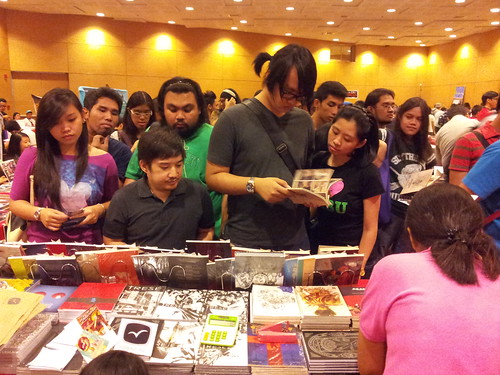
Anyway! The Summer Komikon was fantastic. The star of the Visprint table were (as always) Manix Abrera with his 10th volume of Kikomachine Komix, the editors of Abangan: The Best Philippine Comics 2014, and Mervin Malonzo, with the print version of his webcomic, Tabi Po. I was there signing copies of my two books. Check out my headband.


Untitled

Untitled

Untitled

Untitled
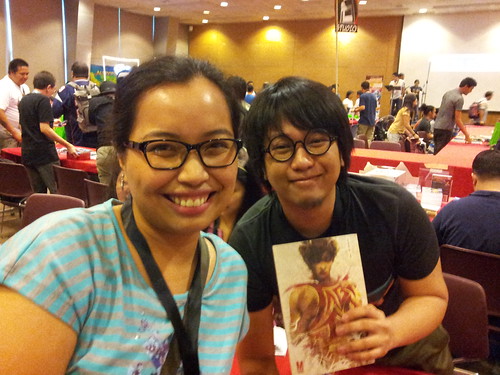
With Mervin and his book. Congrats!

Untitled

Funny about Manix: you had to take a number to have your copy signed. We were there early. We got #67. Sixty-seven! After 30 minutes I asked what number was being served, and they said #12. Dyos ko. Daig pa ang doctor’s clinic. Char.

Congrats Manix and please sign my books next time I see you.

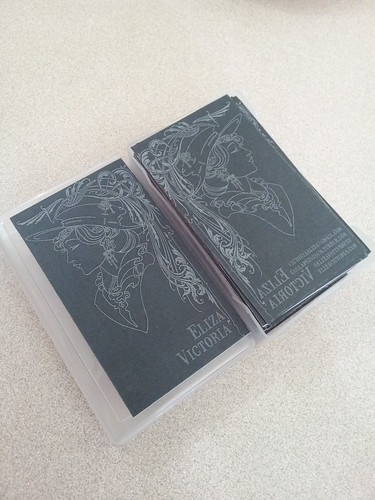
Got these cards that I ordered from Shani Tan of Aromateria. Pretty! I’ll be giving these out to readers in upcoming events.
Untitled

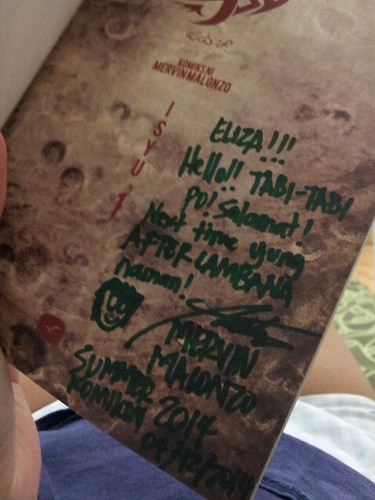
Mervin’s promise regarding After Lambana. Posting this here SO EVERYONE WILL KNOW.
Untitled

We left Komikon early (with Honey, Adam, and Ken) to attend Gina Apostol‘s Lecture & Book Signing at Glorietta 1. I have not read a novel of hers, but I deeply admire and enjoy her essays, like this one, on reading/writing novels, and Rizal.

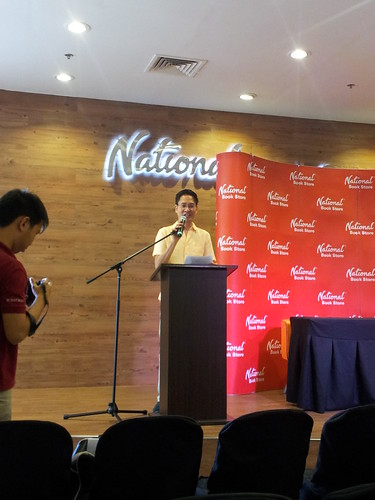
Enjoyed Danton Remoto’s introduction, particularly the Doris Lessing anecdote. (He asked her if they could have a picture taken with her; the British novelist and poet said no. “We’re in New York, but I’m from Loyola Heights, you know. Hindi ko naman alam na may mga protocol na ganyan!”)
Untitled

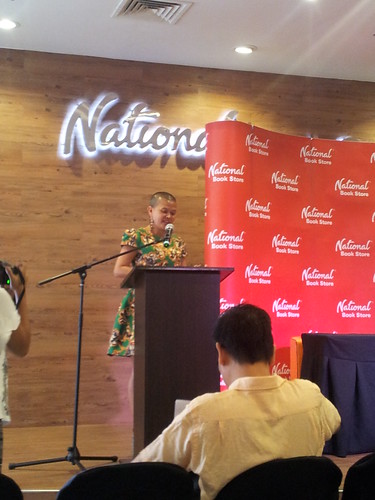
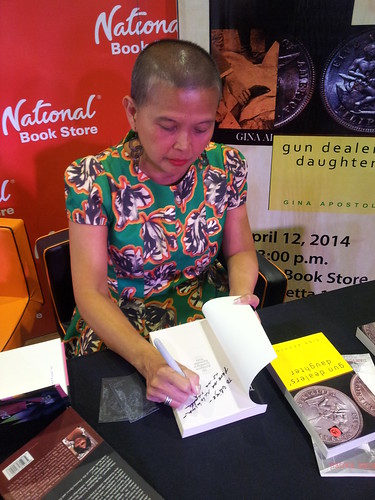
Gina Apostol was equally hilarious, reading sections from her novels Gun Dealers’ Daughter, and The Revolution According to Raymundo Mata. I only brought money for Gun Dealer’s Daughter but (and I told her this) ended up getting Raymundo Mata as well because I enjoyed her reading and discussion so much. Rizal and the revolution through the eyes of a “kooky” blind man. (Raymundo Mata was the blind man who went with Pio Valenzuela in his controversial 1896 visit to Rizal in Dapitan.) Premise pa lang ulam na.

Gina said Raymundo Mata is actually her favorite. I have started reading it and it. Is. Hilarious. Also very inventive and carefully and beautifully written. Check it out.
Untitled

Untitled

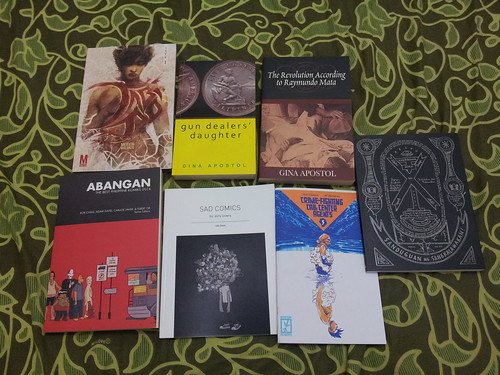
My little loot at the end of the day. Happy.
Untitled

‘let’s talk philippine comics’ with studio salimbal

On Sunday afternoon, we went to Fully Booked High Street to meet up with the comics creators comprising Studio Salimbal.

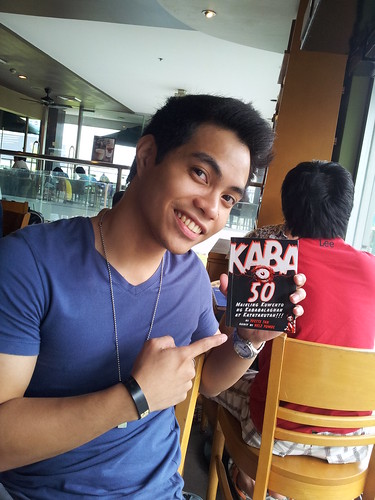
Since we were there early we had lunch first and I hunted down a copy of Yvette Tan’s Kaba, her collection of 50 scary tales in Filipino. It’s so small! Here’s a copy, with my brother for scale.

Studio Salimbal

Studio Salimbal

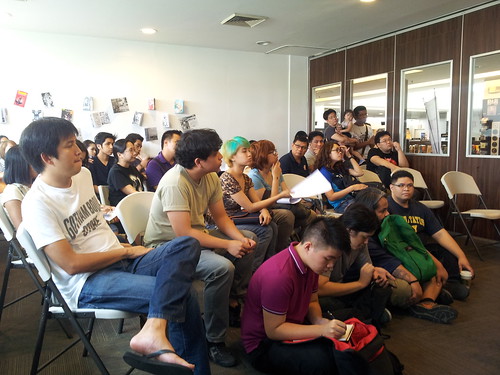
The talk started on time at the Forum (4th Floor, Fully Booked, right on the floor with all of the comics). I was surprised by the number of people who showed up. Some had to sit on the floor, or stand up at the back and outside the door.

Here’s Paolo Chikiamco talking about Studio Salimbal.

Studio Salimbal

Something about the studio:

There’s a lot of talent out there.

Within the Philippines and without, there is a glut of wonderful artists, incredible writers. If you’re a comics fan, you almost have too many choices, both paid and free, in terms of genres and formats and creators (not to mention the other media battling for your attention).

I’m not complaining, mind you — as a reader, as a fan, this is a golden age. As a creator, seeing so many good stories is a welcome challenge.

But it must be said: To reach readers in this golden age, it’s not enough to simply be good — you have to stand out.

It can be a daunting task for one person —

— less so, for fourteen.

Say hello to Studio Salimbal:
* John Amor (Urban Animal) http://johnamorartist.com/
* Koi Carreon (Mythspace: Lift Off) http://eclectic-lights.blogspot.com/
* Paolo Chikiamco (Mythspace) http://www.rocketkapre.com/
* Cristina Rose Chua (Mythspace: Humanity)http://ceearrchua.tumblr.com/
* Mico Dimagiba (Mythspace: Uncommon Ground)http://libpoint.blogspot.com/
* Jules Gregorio (Mythspace: Devourers of Light) http://julesgregorio.carbonmade.com/
* Mervin Malonzo (Tabi Po) http://www.mervinmalonzo.com/
* Butch Mapa (Grimm Fairy Tales: Realm Knights) http://butchmapa.wordpress.com/
* Elbert Or (Bakemono High) http://elbertor.com/
* Tintin Pantoja (Who is AC?) http://tinpantoja.tumblr.com/
* Noel Pascual (Crime Fighting Call Cente Agents) http://conceptualleaf.tumblr.com/
* Paul Quiroga (Mythspace: Black Mark) http://kirogi-dog.deviantart.com/
* Borg Sinaban (Mythspace: Unfurling of Wings)http://borgsinaban.tumblr.com/
* Budjette Tan (Trese) http://tresekomix.blogspot.com/

Our goals are simple: to create comics, and to create a community. To do so creatively, coherently, consistently.

We will be in stores. We will be at conventions. But we’ll also be online in a big way, with most of our stories being serialized as webcomics, because that allows us to give readers something new easily, consistently, and constantly.

How constant? By 2015, we believe we will have enough comics that we’ll be able to publish a new page every weekday for the entire year.

Our site at salimbalcomics.com — designed by the multi-talented Mervin Malonzo — will be launching this April. We’ll be running Mythspace: Lift Off as our lone weekly comic to start, followed by another Mythspace story later in the year. We’ll be using this year to test the waters, to form a community, to get used to working as a team. But behind the scenes, we’re already working on next year’s stories, and it’s a buffer we’ll be looking to maintain moving forward.

The goal is simple — not easy. But that’s why we’re doing this together — and why we would love to have you all along for the ride.

The Salimbal, after all, is a magical ship from Philippine folktales that allows people to travel to a better future. In our case, we’re hoping that our own tales will help create a better future for Philippine comics.

I sat at the Writers Panel, and we talked about our processes, schedules, the places where we get our ideas, and a little about problematizing the Filipino identity as writers (which I think deserves a panel all of its own).

Studio Salimbal

The next two panels were for the artists, and a presentation of future projects. Important topics discussed were the sustainability of the industry (can we earn enough to quit our day jobs and just produce comics?), production (is it possible to not tailor our production around the convention schedules, ie can we produce more than two new titles a year, or at least finish an entire run instead of releasing several First Issues?), and distribution (can we distribute in places other than the book stores?).

I went up and presented After Lambana, which you can read about here.

After the talks closed, I had the chance to say hi to Bea Pantoja of The Dalaga Project. I didn’t know she was Tintin’s sister!

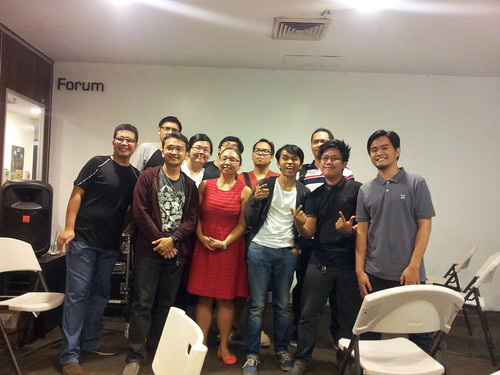
And here is Studio Salimbal, posing for their class picture.

Studio Salimbal

A random celebrity sighting when we left the venue. My brother with Marc Abaya. Notice the book he’s holding. :)

A final pose before we headed to IHOP. Breakfast for dinner, the best kind of dinner.

Studio Salimbal

Many thanks to Paolo for the invite, and to Mervin for the great art for After Lambana. Mervin is aiming to finish the book this year, so we can have a print run next year. Exciting times ahead.

I’ll be at the Komikon next week! See you all there.

coming soon: ‘after lambana’ – words & story by eliza victoria, art by mervin malonzo

One day I was reading up on the Prohibition Era and the many ways people tried to find loopholes in this ill-conceived law (for example, pharmacists could dispense whiskey for whatever illness, so after the law was passed all of a sudden there were A LOT of pharmacists), and I thought of injecting some elements of fantasy in this scenario.

What if there is such a thing as Magical Prohibition, and people are getting sick with illnesses of magical origin? Will people break the law just to be cured? How will doctors deal with these diseases? Will HMOs cover this? And so on.

The story that emerged from this “What if” is After Lambana.

Here is the blurb, as I initially pitched it to artist Mervin Malonzo:

Lambana, the realm of the Diwata, has fallen, the Magical Prohibition Act has been signed into law, and there is something wrong with Conrad’s heart. Only magic can delay his inevitable death, and so he meets with Ignacio, a friend who promises to hook him up with Diwata and magic-derived treatments, illegal though this may be.

But during the course of the night, Conrad may just discover Lambana’s secrets – and a cure to save his life.

My script runs for around 160 pages, but the events will occur in only one night.

Here are two teasers created by Mervin: one showing our two main characters (Conrad and Ignacio), and one featuring blood and flowers.

Beautiful and violent.

I am excited about this, Mervin is excited about this, and I hope this is a story you all will look forward to and support.

Thanks for reading!

‘demons of the new year’ reviewed in philippines graphic

Joel Pablo Salud says of “Salot”:

Eliza Victoria’s Salot takes whatever is left in the ongoing fondness for tales on superstition and carries it to the next level. Unlike stories that make one think it can only happen to someone else, she brings the horror of delusions and poltergeists not at someone’s doorsteps, but right into the very rooms and windows of the house.

Penned in silver-tongue prose, Eliza Victoria dabbles with provincial folktales thick with ghosts and voices from out of nowhere, and tells it from the eyes of a doubting Isabella. The doubts expressed were seemingly essential to the storytelling as it kept the reader from making any hard conclusions, such as those detrimental to the sustained reading of the tale. To capture one’s attention and keep it on the road, by far, is Eliza Victoria’s strongest suit. Suffice it to say that in Salot, Victoria’s storytelling has reached its zenith.

Read the full review here.

Please grab a copy of Demons of the New Year, edited by Karl De Mesa and Joseph Nacino, and published by UP Press.

“Salot” also appears in my short story collection, A Bottle of Storm Clouds, published by Visprint Inc. 

studio salimbal forum on april 6 @ fully booked high street


Hello! We are Studio Salimbal – you may know us individually, but as a group, we’re brand new and raring to go. We’re working on a lot of comics, but for our first project, we’d like to talk – talk about Philippine Comics, to be precise, so you’re all invited to get together with us at 2:30pm, on April 6 (Sunday), at the Forum at Fully Booked Hightstreet. We’ll have a series of open panels where Salimbal members, as well as any creators who would like to come, can talk shop, and compare projects and goals for the future. Oh, and there will be free sketches too!


I will be here as a comics creator (haaaaaaaaaaaaaaaaaawhat how new and exciting) on the writers panel. I will be introducing the project Mervin and I are working on and will share 1) the title (ha!) 2) the blurb/what it’s about 3) maybe sketches?

April 6! Paolo Chikiamco (Rocket Kapre/Mythspace) will be introducing Studio Salimbal to the world. You can like their page for updates and more info. See you guys.

movie reviews

12 Years A Slave

If you want to convey the horrors of slavery, you don’t need to do much – the very idea is horrific in itself. Steve McQueen’s film based on freeman-turned-slave Solomon Northup’s memoir is bare and lean and stark. I have read (though I can’t verify) that the film was shot with one camera for 35 days, and you can see the economy in the use of images. It opens with a silent shot of Solomon with a number of slaves staring at an as-yet unseen master. There is no intensity in their eyes. No fight. No life. Most scenes are silent with no non-diegetic music and no dialogue. How do you convey the horror of lynching? Show several minutes of Solomon with a noose around his neck, abandoned by his would-be lynchers, standing on tiptoes from sun-up to sundown while slaves go about their chores, not wanting to be whipped by getting involved. There are stretches of rare beauty — the music (singing on the field), moments of peace (Patsey creating her corn dolls) — but the film is only made bearable by my knowing that Solomon will be reunited with his family. I did not know about Solomon prior to this film. I did not know that freemen (Solomon was born to a freed slave and a free woman of color) were kidnapped and brought to states where slavery was legal in order to be sold. The fact that I had to say “free woman of color”, that I had to qualify, makes me choke by the grim injustice of it all. Goddamn it, let’s not allow ourselves to do this again.

The Wolf of Wall Street

Speaking of the economy in the use of images, Scorsese’s The Wolf of Wall Street ends with a shot of men and women attending Jordan Belfort’s motivational talk, looking on, waiting for wisdom to sink in. You can almost smell the despair and hope – and it serves as an indictment. It is the best image with which to close this film, this shameless show of debauchery and disgusting excess. Belfort and his ilk are loathsome creatures, and they are fascinating, but they do not deserve our admiration.

To quote Matt Soller Seitz:

There will be a few points during “Wolf” when you think, “These people are revolting, why am I tolerating this, much less getting a vicarious thrill from it?” At those moments, think about what the “it” refers to. It’s not just these characters, and this setting, and this particular story. It’s the world we live in. Men like Belfort represent us, even as they’re robbing us blind. They’re America, and on some level we must be OK with them representing America, otherwise we would have seen reforms in the late ’80s or ’90s or ’00s that made it harder for men like Belfort to amass a fortune, or that at least quickly detected and harshly punished their sins. Belfort was never punished on a level befitting the magnitude of pain he inflicted. According to federal prosecutors, he failed to abide by the terms of his 2003 restitution agreement. He’s a motivational speaker now, and if you read interviews with him, or his memoir, it’s obvious that he’s not really sorry about anything but getting caught. We laugh at the movie, but guys like Belfort will never stop laughing at us.

I am reminded of the infamous Enron tapes while watching this.

In the now infamous Grandma Millie exchange, recorded on Nov. 30, 2000, two traders, identified as Kevin and Bob, discuss demands by California officials that electricity-generating companies and traders pay refunds for price-gouging. They also refer to the disputed presidential election, which was as yet undecided.

Kevin: So the rumor’s true? They’re [expletive] takin’ all the money back from you guys? All those money you guys stole from those poor grandmothers in California?

Bob: Yeah, Grandma Millie, man. But she’s the one who couldn’t figure out how to [expletive] vote on the butterfly ballot.

Kevin: Yeah, now she wants her [expletive] money back for all the power you’ve charged for [expletive] $250 a megawatt hour.

Bob: You know — you know — you know, Grandma Millie, she’s the one that Al Gore’s fightin’ for, you know?

Later in the same conversation, Kevin and Bob express little sympathy for Californians.

Kevin: Oh, best thing that could happen is [expletive] an earthquake, let that thing float out to the Pacific and put ’em [expletive] candles.

Bob: I know. Those guys — just cut ’em off.

Kevin: They’re so [expletive] and they’re so like totally — —

Bob: They are so [expletive].

Nothing funny about these disgusting men.

Ender’s Game

This film adaptation is a visual treat, and it’s a good translation of a good book. The writers made changes but kept the essence of the narrative intact. The SFX and the film’s overall design are stunning.

‘V is for Eliza Victoria’s Project 17’

Oh wow, Project 17 is mentioned in this essay (“An ABC of Kickass, or A Partial Exorcism of My TBR/TBRA* Pile”) by Lightspeed staffer Jude Griffin.

V is for Eliza Victoria’s Project 17: Orwell with robots! And world-building that feels all too real.

AAAAAHHHHHHH. To be mentioned with Orwell in the same breath. And this is a great list, too! Thank you Jude!